
21 October 2026
Semax in two 2025 animal-model papers
Download PDF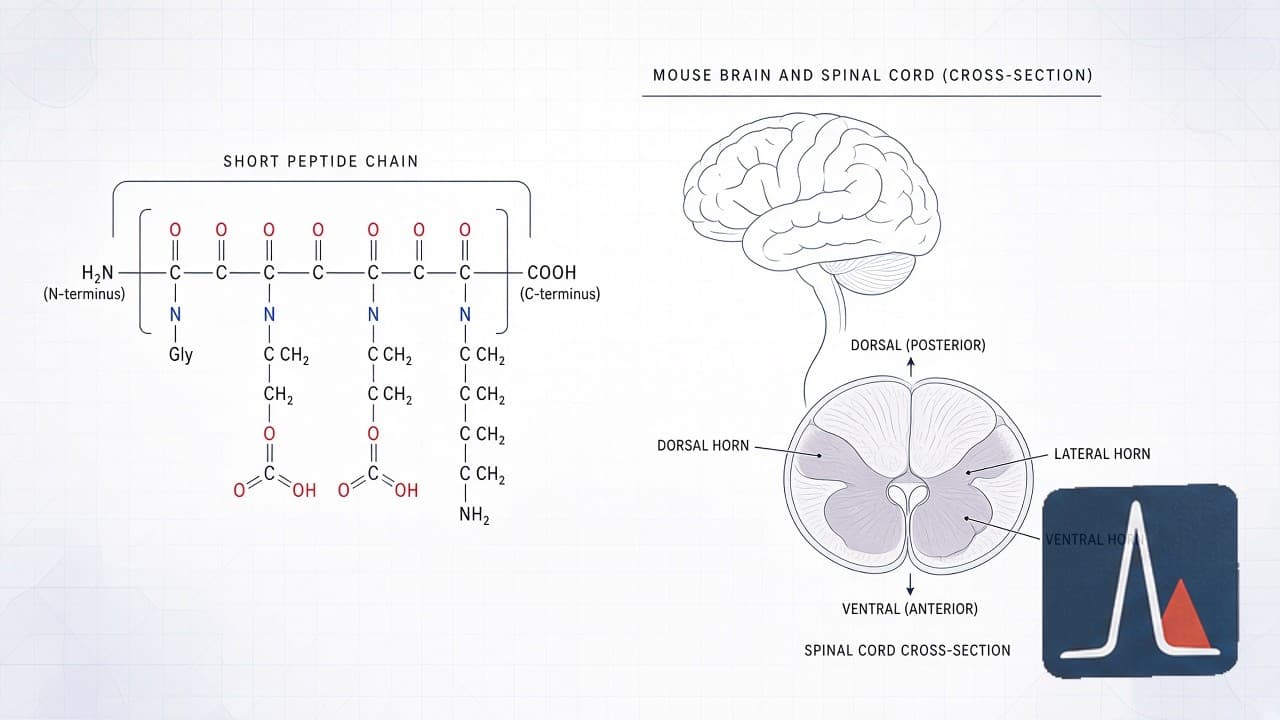
Two 2025 papers reported animal-model measurements after Semax exposure in transgenic Alzheimer mice and in female mice after spinal cord injury. Neither paper is a clinical study.
Researchers looking up Semax will find two 2025 reports that name animal models, not clinical trials.
Radchenko and colleagues used APPswe/PS1dE9/Blg mice and compared Semax with a derivative on open-field, novel-object recognition, and Barnes maze tests. The abstract reports differences in those behavioral measures and a lower count of amyloid inclusions in cortex and hippocampus versus the comparison condition used in the study. Study type: animal model. Limitation: the work is confined to a transgenic mouse line; the abstract does not report human participants or clinical endpoints, and wording about corrective potential is an author interpretation beyond the measured counts and test scores.
Liu and colleagues studied female mice after spinal cord injury, with related neuroinflammation models. The paper reports scores described as functional recovery and lower markers linked to lysosomal-membrane-permeabilization-related pyroptosis. Sequencing, pharmacology, knockdown, network pharmacology, and docking were used to propose an Oprm1–USP18–FTO pathway. Study type: animal model (with cell-model components). Limitation: findings are from female mice and cell systems; pathway statements rest on those assays and docking, not on a clinical study.
Neither paper supplies a clinical result. Counts, test scores, and marker changes in these models are study reports only.
Sources
- Radchenko AI et al. The Potential of the Peptide Drug Semax and Its Derivative for Correcting Pathological Impairments in the Animal Model of Alzheimer's Disease. 2025. DOI: 10.32607/actanaturae.27808. PubMed: 41479572.
- Liu R et al. Semax peptide targets the μ opioid receptor gene Oprm1 to promote deubiquitination and functional recovery after spinal cord injury in female mice. 2025. DOI: 10.1111/bph.70122. PubMed: 40692165.
More briefings
- Survodutide Dual Agonist: Preclinical and Clinical EvidenceThe open-catalog entry for survodutide describes a synthetic acylated 29-amino-acid peptide dual agonist of glucagon and GLP-1 receptors supplied as high-purity lyophilized powder for laboratory metabolic research. Randomised trials report
- Dulaglutide: GLP-1 Receptor Agonist in Metabolic CareDulaglutide is a recombinant Fc-fusion GLP-1 receptor agonist engineered for once-weekly administration in laboratory and clinical metabolic research. Randomised trials report glycaemic improvements, cardiovascular risk reduction and modest
- Cagrilintide-Semaglutide Mixture: Open-Catalog Context and Metabolic Trial EvidenceThe open-catalog cagrilintide-semaglutide mixture supplies a research pairing of an amylin receptor agonist and GLP-1 receptor agonist for laboratory metabolic studies. Randomised trials of co-administration report enhanced weight loss (13–
All information and products discussed are for laboratory and research use only. Not for human or veterinary use. Not intended to diagnose, treat, cure, or prevent any disease.