
19 October 2026
Published reports on elamipretide (SS-31)
Download PDF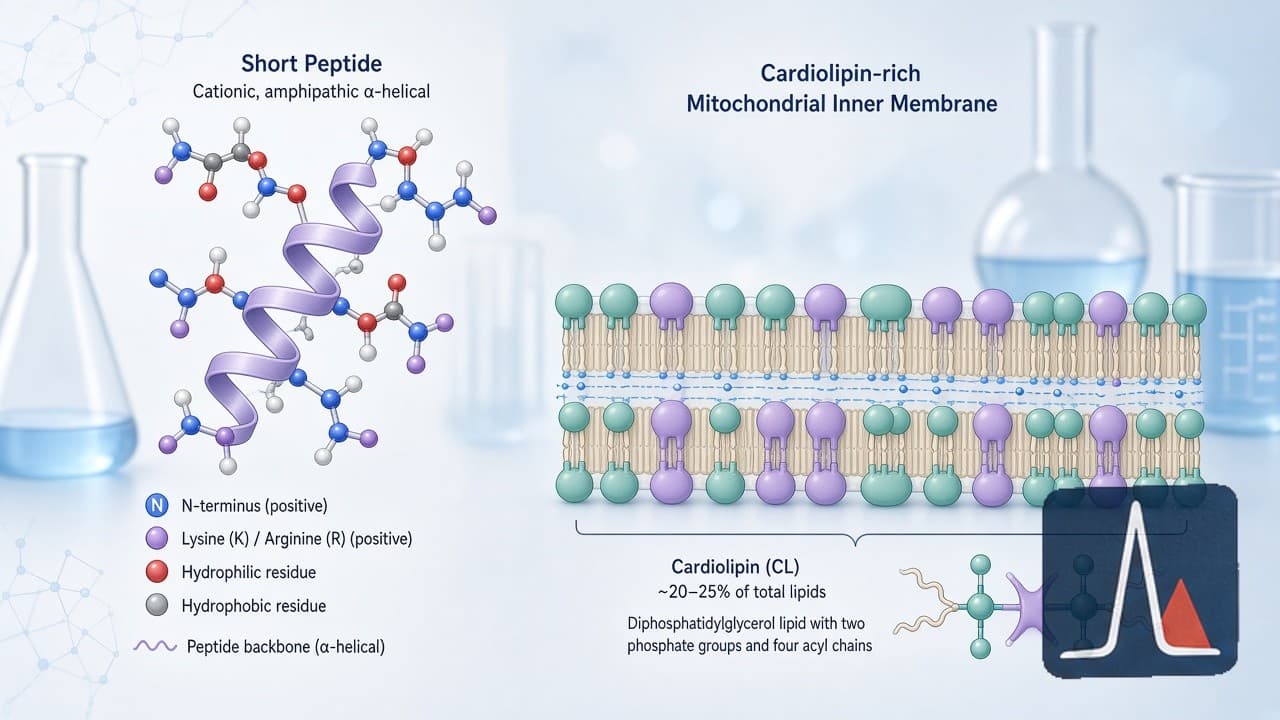
Four published records describe a commentary on a clinical crossover trial and three animal-model papers on elamipretide (SS-31), one of which also included a cell assay.
Researchers reviewing the laboratory peptide elamipretide (SS-31) can use the following published reports. Each item is a study finding, not a use recommendation.
A 2026 commentary described a randomized, double-blind, placebo-controlled crossover trial (clinical) in Barth syndrome. It reported no significant difference between elamipretide and placebo on the 6-minute walk test or fatigue scores. The same commentary described sustained changes during a 168-week open-label extension and noted that accelerated approval required a confirmatory trial. Limitation: this is a commentary, not the primary trial report; the open-label extension, as described, lacked a concurrent placebo control, and the retrieved record did not include full methods or participant counts.
A 2026 paper used a mouse thoracic contusion model (animal model) and parallel PC12-cell assays (in vitro). It reported higher locomotor and gait measures, less lesion pathology, and differences in apoptosis-related and remodeling markers after elamipretide exposure compared with injury controls. The cell assays reported preserved mitochondrial membrane potential under oxidative stress. Limitation: abstract-level animal and cell data; the retrieved record did not list sample sizes; these findings are not human outcome data.
A 2026 paper in a rat model of heart failure with preserved ejection fraction (animal model) reported higher soleus and extensor digitorum longus contractile measures, altered titin phosphorylation, and less fiber atrophy with elamipretide exposure than in untreated model animals, with reported differences in cardiolipin and mitochondrial measures. Limitation: a single preclinical model, available here as an abstract-only record, with no human outcomes.
A 2025 aging-mouse study (animal model) reported differences in cardiac and skeletal muscle function measures after elamipretide exposure compared with controls, without detectable changes in tissue epigenetic or transcriptomic age. Limitation: mouse model only; the retrieved abstract did not provide group sizes or exposure details.
Sources
- Elamipretide: The first cardiolipin-directed mitochondrial therapeutic for Barth syndrome approved under accelerated approval. 2026. DOI: 10.5582/ddt.2025.01111. https://pubmed.ncbi.nlm.nih.gov/41260682/ - Elamipretide (SS-31) promotes recovery by preserving mitochondrial bioenergetics and neural remodeling after spinal cord injury. 2026. DOI: 10.1016/j.neuint.2026.106171. https://pubmed.ncbi.nlm.nih.gov/42082001/ - Targeting Mitochondrial Dysfunction With Elamipretide (SS-31) Improves Skeletal Muscle Performance in a HFpEF Rat Model. 2026. DOI: 10.1161/CIRCHEARTFAILURE.126.014397. https://pubmed.ncbi.nlm.nih.gov/42290373/ - The Mitochondria-Targeted Peptide Therapeutic Elamipretide Improves Cardiac and Skeletal Muscle Function During Aging Without Detectable Changes in Tissue Epigenetic or Transcriptomic Age. 2025. DOI: 10.1111/acel.70026. https://pubmed.ncbi.nlm.nih.gov/40080911/
More briefings
- Survodutide Dual Agonist: Preclinical and Clinical EvidenceThe open-catalog entry for survodutide describes a synthetic acylated 29-amino-acid peptide dual agonist of glucagon and GLP-1 receptors supplied as high-purity lyophilized powder for laboratory metabolic research. Randomised trials report
- Dulaglutide: GLP-1 Receptor Agonist in Metabolic CareDulaglutide is a recombinant Fc-fusion GLP-1 receptor agonist engineered for once-weekly administration in laboratory and clinical metabolic research. Randomised trials report glycaemic improvements, cardiovascular risk reduction and modest
- Cagrilintide-Semaglutide Mixture: Open-Catalog Context and Metabolic Trial EvidenceThe open-catalog cagrilintide-semaglutide mixture supplies a research pairing of an amylin receptor agonist and GLP-1 receptor agonist for laboratory metabolic studies. Randomised trials of co-administration report enhanced weight loss (13–
All information and products discussed are for laboratory and research use only. Not for human or veterinary use. Not intended to diagnose, treat, cure, or prevent any disease.