
21 October 2026
Published laboratory reports on LL-37 and related sequences
Download PDF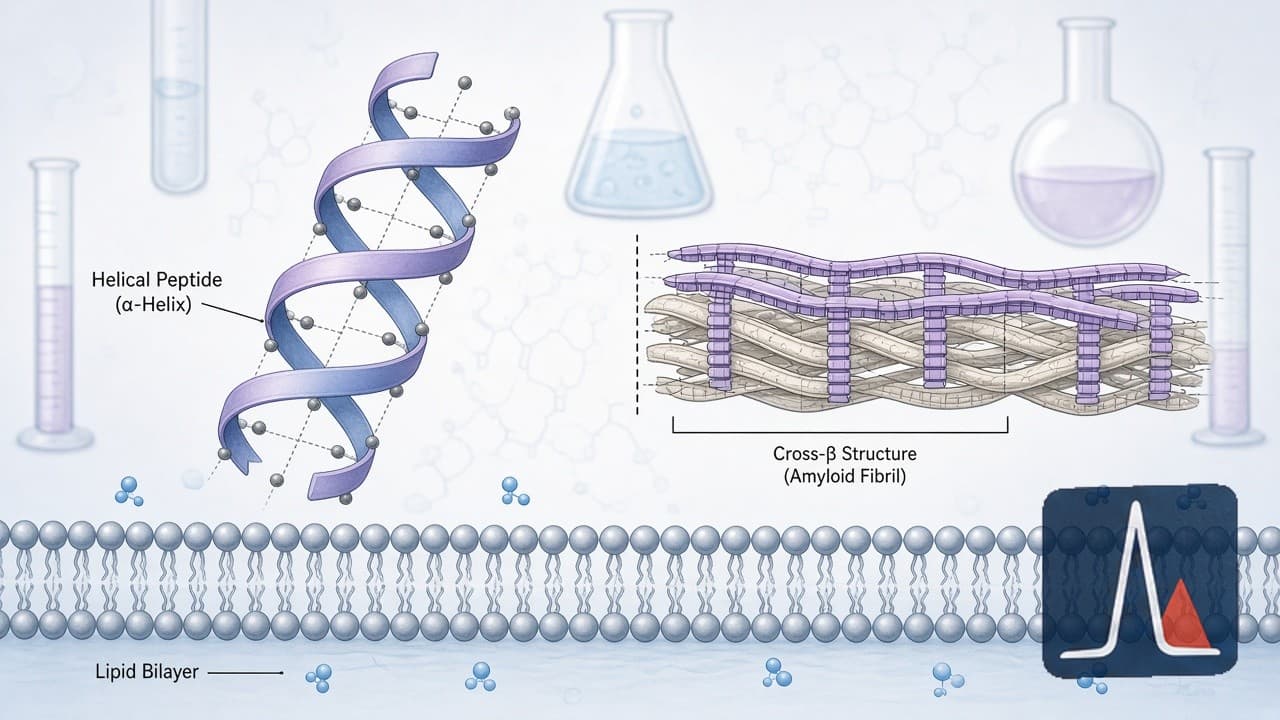
Indexed 2025 papers reported in vitro findings on LL-37, truncated fragments, and a designed derivative, plus a review of modification strategies. No clinical outcomes were stated in the records used here.
Researchers reviewing LL-37 will find four 2025 indexed reports below. Each statement is limited to what the paper reported.
A biophysical study (in vitro) reported that LL-37 and three truncated fragments formed hetero-oligomers and nanoclusters with amyloid-β40, inhibited Aβ40 fibrillation, and differed in effects on nucleation, elongation, and cluster size. Limitation: the record used here is an indexed abstract of cell-free, scale-dependent aggregation assays, not a clinical study; fragment-specific results were not presented as findings for intact LL-37 alone.
A laboratory study (in vitro) reported that a designed cathelicidin- and defensin-related antimicrobial peptide bound bacterial lipid membranes, disrupted membranes in leakage assays, and showed lower minimum inhibitory concentrations and faster bactericidal kinetics than parent LL-37 against multidrug-resistant Escherichia coli and ESKAPE strains. Limitation: assays were in vitro; the tested sequence was a designed derivative, not unmodified LL-37; the abstract did not report clinical outcomes.
A cell-based study (in vitro) reported that, among eight cathelicidin-derived peptides screened computationally and tested on colon cancer cell lines, LL-37 and FK-16 were the leading candidates and LL-37 showed the strongest inhibitory effects on HT-29 and SW-620 cells. Limitation: virtual screening plus cultured-cell assays; the abstract did not report animal-model or clinical outcomes for anticancer activity.
A 2025 review reported that human cathelicidin LL-37 has been studied for antimicrobial and immunomodulatory activity and summarized chemical and structural modification strategies intended to change properties of LL-37-related peptides. Limitation: narrative review, not a new primary experiment; modification strategies are not a clinical result.
Sources
- LL-37 and Its Truncated Fragments Modulate Amyloid-β Dynamics, Aggregation and Toxicity Through Hetero-Oligomer and Cluster Formation (2025). https://doi.org/10.1002/anie.202516241
- Biophysical and transcriptomic characterization of LL-37-derived antimicrobial peptide targeting multidrug-resistant Escherichia coli and ESKAPE pathogens (2025). https://doi.org/10.1038/s41598-025-22890-7
- Virtual Screening of Cathelicidin-Derived Anticancer Peptides and Validation of Their Production in the Probiotic Limosilactobacillus fermentum KUB-D18 Using Genome-Scale Metabolic Modeling and Experimental Approaches (2025). https://doi.org/10.3390/ijms262010077
- Antimicrobial Peptides of the Cathelicidin Family: Focus on LL-37 and Its Modifications (2025). https://pubmed.ncbi.nlm.nih.gov/40869425/
More briefings
- Survodutide Dual Agonist: Preclinical and Clinical EvidenceThe open-catalog entry for survodutide describes a synthetic acylated 29-amino-acid peptide dual agonist of glucagon and GLP-1 receptors supplied as high-purity lyophilized powder for laboratory metabolic research. Randomised trials report
- Dulaglutide: GLP-1 Receptor Agonist in Metabolic CareDulaglutide is a recombinant Fc-fusion GLP-1 receptor agonist engineered for once-weekly administration in laboratory and clinical metabolic research. Randomised trials report glycaemic improvements, cardiovascular risk reduction and modest
- Cagrilintide-Semaglutide Mixture: Open-Catalog Context and Metabolic Trial EvidenceThe open-catalog cagrilintide-semaglutide mixture supplies a research pairing of an amylin receptor agonist and GLP-1 receptor agonist for laboratory metabolic studies. Randomised trials of co-administration report enhanced weight loss (13–
All information and products discussed are for laboratory and research use only. Not for human or veterinary use. Not intended to diagnose, treat, cure, or prevent any disease.