
21 October 2026
Published 2025–2026 reports on Semax
Download PDF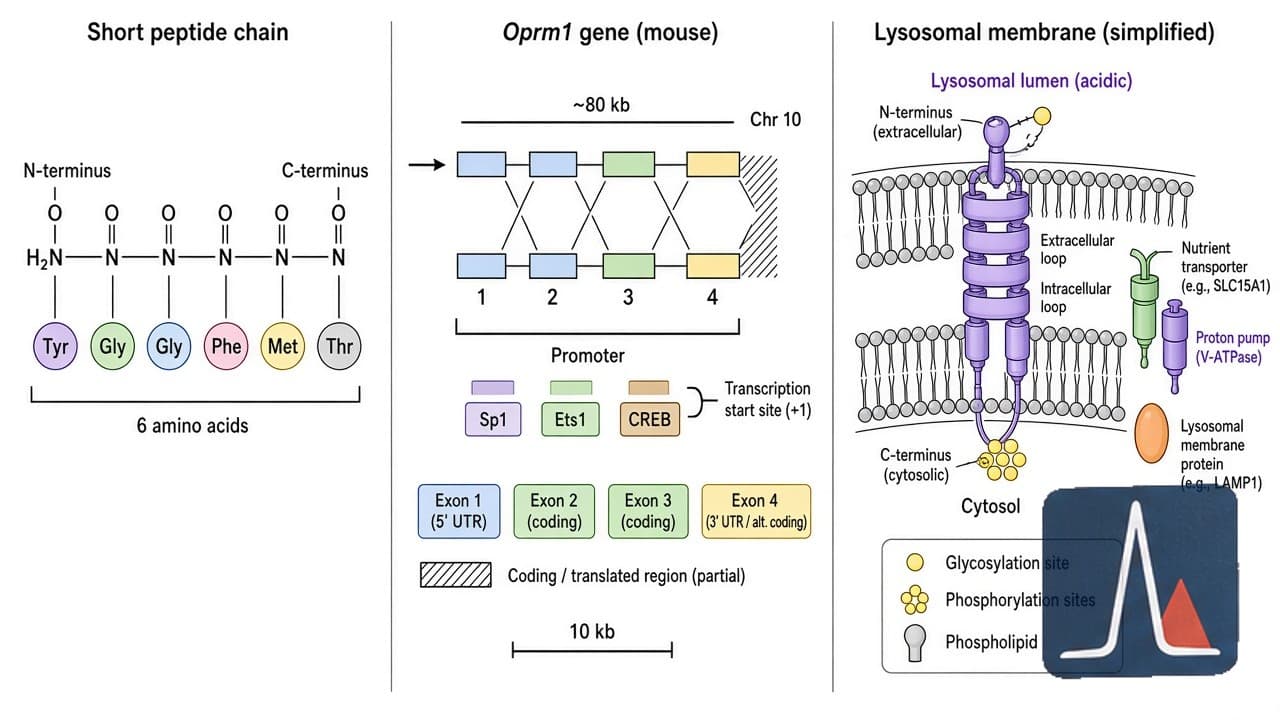
Four PubMed-indexed papers from 2025–2026 report animal-model experiments or narrative reviews involving Semax. None of the records summarized here is a clinical study, and two reviews do not present original Semax measurements.
This briefing covers Semax only as described in four published records from 2025–2026. Study type is stated for each. No clinical trial is included in this set.
Animal model (2025). Liu and colleagues reported that Semax targeted the mu opioid receptor gene *Oprm1*, with reported deubiquitination-related findings, and that functional recovery measures changed after spinal cord injury in female mice. The paper also reported inhibition of lysosomal-membrane-permeabilization-related pyroptosis in neuroinflammation models. Limitation: the available abstract does not fully separate mouse and model results, the injury experiments are limited to female mice, and human outcomes are not reported.
Animal model (2025). Radchenko and colleagues reported an assessment of Semax and a derivative on behavioral characteristics and amyloidosis development in transgenic APPswe/PS1dE9/Blg mice used as an Alzheimer’s disease model. Limitation: the available record states what was assessed but does not include measured outcomes or their direction.
Review (2026). Mavrych, Shypilova, and Bolgova identified Semax among peptides discussed in aging literature under a neuroprotection category. Limitation: this is a narrative review, not a new experiment, and the available text does not report original measurements for Semax.
Review (2026). Rahman, Lee, and Seeds stated that neuroactive peptides including Selank, Semax, and Dihexa enhance brain-derived neurotrophic factor and HGF/c-Met pathways. Limitation: the wording groups three peptides and does not present primary data or clinical results for Semax alone.
Sources
- Liu R, et al. Semax peptide targets the mu opioid receptor gene Oprm1 to promote deubiquitination and functional recovery after spinal cord injury in female mice. 2025. https://doi.org/10.1111/bph.70122 — https://pubmed.ncbi.nlm.nih.gov/40692165/
- Radchenko AI, et al. The Potential of the Peptide Drug Semax and Its Derivative for Correcting Pathological Impairments in the Animal Model of Alzheimer's Disease. 2025. https://doi.org/10.32607/actanaturae.27808 — https://pubmed.ncbi.nlm.nih.gov/41479572/
- Mavrych V, Shypilova I, Bolgova O. Therapeutic peptides in gerontology: mechanisms and applications for healthy aging. 2026. https://doi.org/10.3389/fragi.2026.1790247 — https://pubmed.ncbi.nlm.nih.gov/42021992/
- Rahman OF, Lee SJ, Seeds WA. Therapeutic Peptides in Orthopaedics: Applications, Challenges, and Future Directions. 2026. https://doi.org/10.5435/JAAOSGlobal-D-25-00236 — https://pubmed.ncbi.nlm.nih.gov/41490200/
More briefings
- Survodutide Dual Agonist: Preclinical and Clinical EvidenceThe open-catalog entry for survodutide describes a synthetic acylated 29-amino-acid peptide dual agonist of glucagon and GLP-1 receptors supplied as high-purity lyophilized powder for laboratory metabolic research. Randomised trials report
- Dulaglutide: GLP-1 Receptor Agonist in Metabolic CareDulaglutide is a recombinant Fc-fusion GLP-1 receptor agonist engineered for once-weekly administration in laboratory and clinical metabolic research. Randomised trials report glycaemic improvements, cardiovascular risk reduction and modest
- Cagrilintide-Semaglutide Mixture: Open-Catalog Context and Metabolic Trial EvidenceThe open-catalog cagrilintide-semaglutide mixture supplies a research pairing of an amylin receptor agonist and GLP-1 receptor agonist for laboratory metabolic studies. Randomised trials of co-administration report enhanced weight loss (13–
All information and products discussed are for laboratory and research use only. Not for human or veterinary use. Not intended to diagnose, treat, cure, or prevent any disease.