
31 October 2026
Liraglutide: Chemical Identity and Catalog Context
Download PDF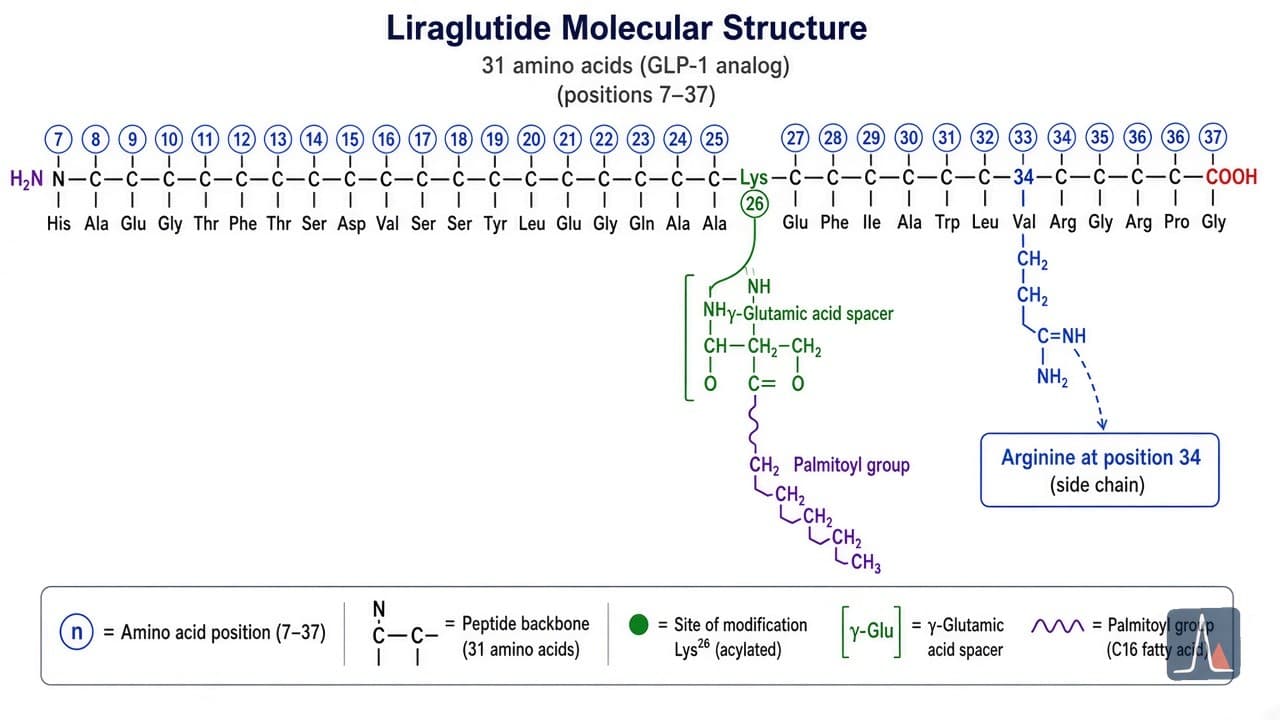
Liraglutide is a synthetic 31-amino-acid lipopeptide analogue of human GLP-1(7-37) with an Arg34 substitution and Lys26 acylated by palmitic acid via a γ-glutamic acid spacer (C172H265N43O51, CAS 204656-20-2). It is tracked as a single disc
Liraglutide: Chemical Identity and Catalog Context
Materials on this site are for laboratory research only. They are not medicines. Reporting published human studies, trials, or reviews is not guidance to use the research material that way.
Liraglutide (Liraglutide) is catalogued as a single, unambiguously defined synthetic lipopeptide. Its molecular formula is C₁₇₂H₂₆₅N₄₃O₅₁ (average mass 3751.2 Da, monoisotopic mass 3748.95 Da), with CAS registry number 204656-20-2 and InChIKey YSDQQAXHVYUZIW-QCIJIYAXSA-N. The 31-residue sequence is derived from human GLP-1(7–37), sharing 97% homology. Two specific modifications define it: substitution of lysine at position 34 with arginine (eliminating the second lysine to ensure site-specific acylation) and N^ε-acylation of lysine 26 with a hexadecanoyl (palmitoyl, C16) group attached through a γ-L-glutamic acid spacer. The free C-terminal carboxylic acid is retained.
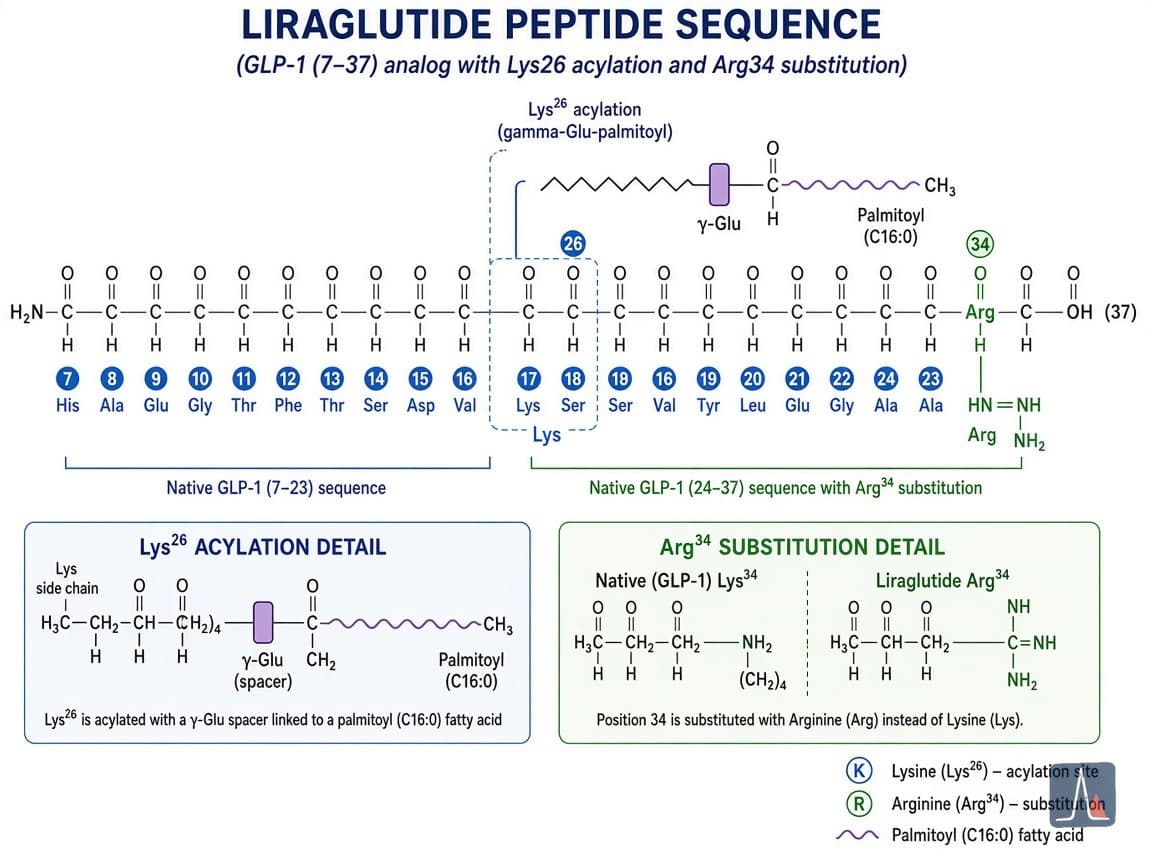
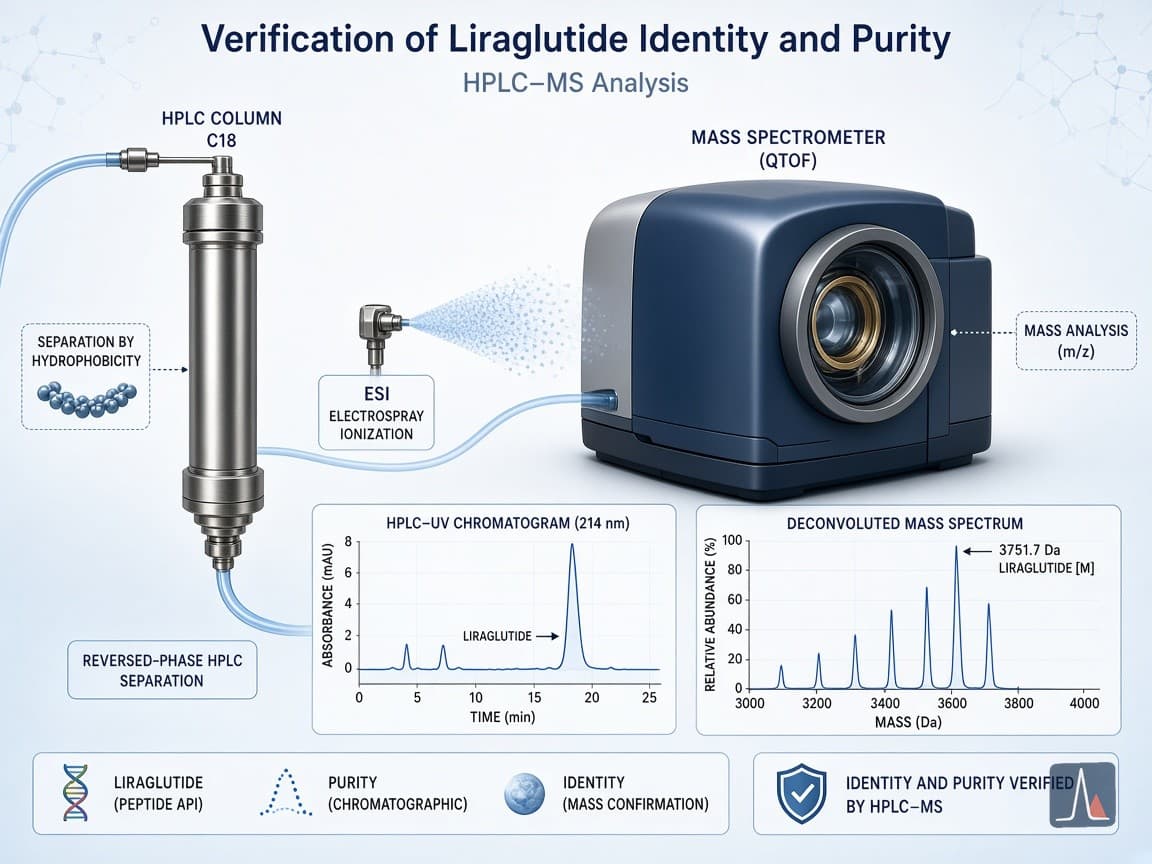
This precise covalent structure is the core reason liraglutide is maintained as one discrete compound entry in the open catalog. The catalog groups research materials by chemical identity. A single, homogeneous molecule with one primary sequence, one defined lipid modification, one CAS number, and one InChIKey receives a dedicated page. This avoids fragmentation that would occur with salt variants, positional isomers, or ill-defined mixtures. It contrasts with catalog entries for deliberate combinations (e.g., cagrilintide + semaglutide), complex polypeptide extracts (e.g., thymalin), or reagents (e.g., BAC water). A researcher consulting the liraglutide page knows exactly which molecule the linked literature describes, facilitating reproducible reconstitution, analytical verification by HPLC and mass spectrometry, and direct mapping to published pharmacology without ambiguity about "which version."
Structural Design and Biophysical Properties
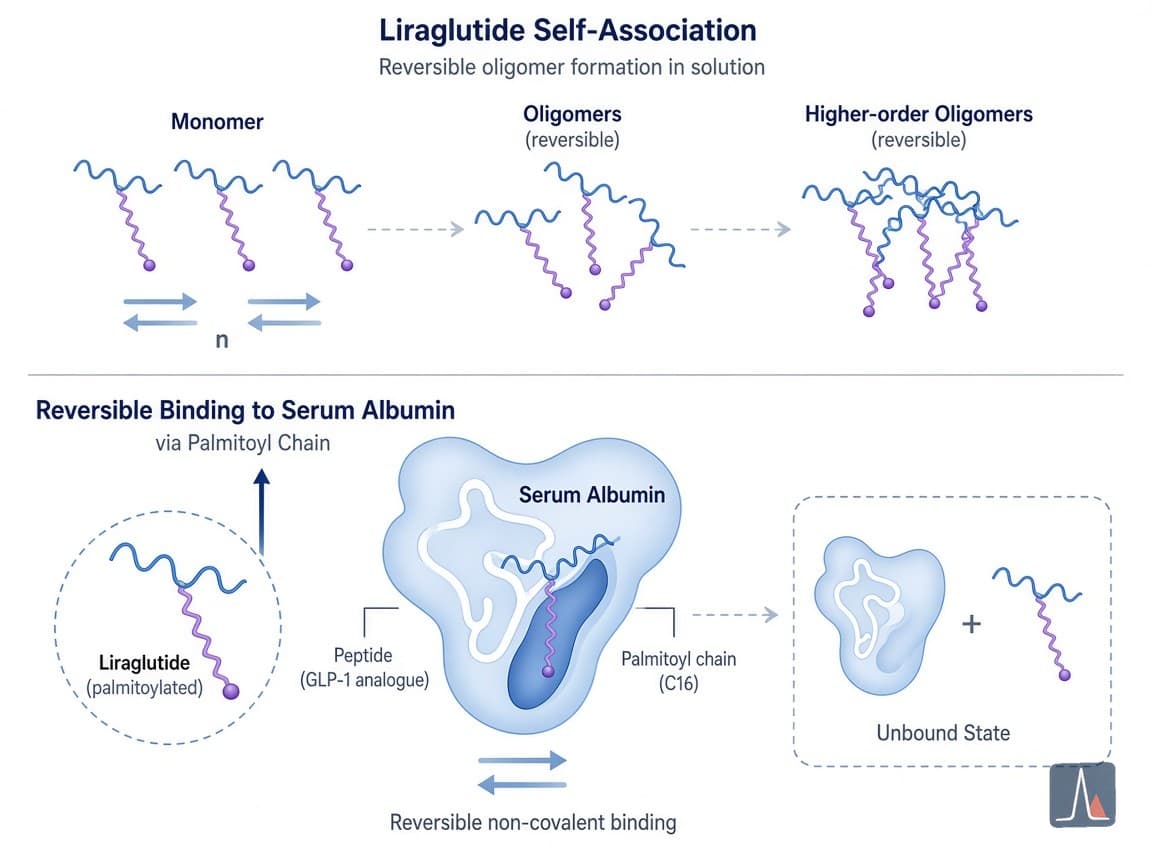
The palmitoyl-γ-glutamyl modification was rationally engineered during medicinal chemistry efforts in the 1990s to exploit endogenous albumin as a reversible carrier. The fatty-acid chain promotes self-association into heptameric structures at higher concentrations (as at the injection site), slowing absorption, while the reversible albumin binding protects the peptide from renal filtration and DPP-4 degradation despite an unmodified N-terminal His-Ala. These properties are intrinsic to this exact structure; altering the chain length, spacer, or acylation site changes albumin affinity, receptor potency, and pharmacokinetics. Structural studies (NMR, SAXS, crystallography) confirm the helix-forming propensity and side-chain orientation that allow high-affinity GLP-1 receptor (GLP-1R) agonism while conferring the desired prolongation.
In laboratory settings, this defined identity supports precise formulation studies examining compatibility with diluents, stability under various pH and temperature conditions, and interactions with other research peptides. The catalog entry therefore serves as the canonical reference for this molecule across all contexts—foundational discovery, in vitro receptor assays, animal models, and human trial data—without requiring separate pages for different indications or formulations.
Foundational Discovery, Receptor Pharmacology, and In Vitro Studies
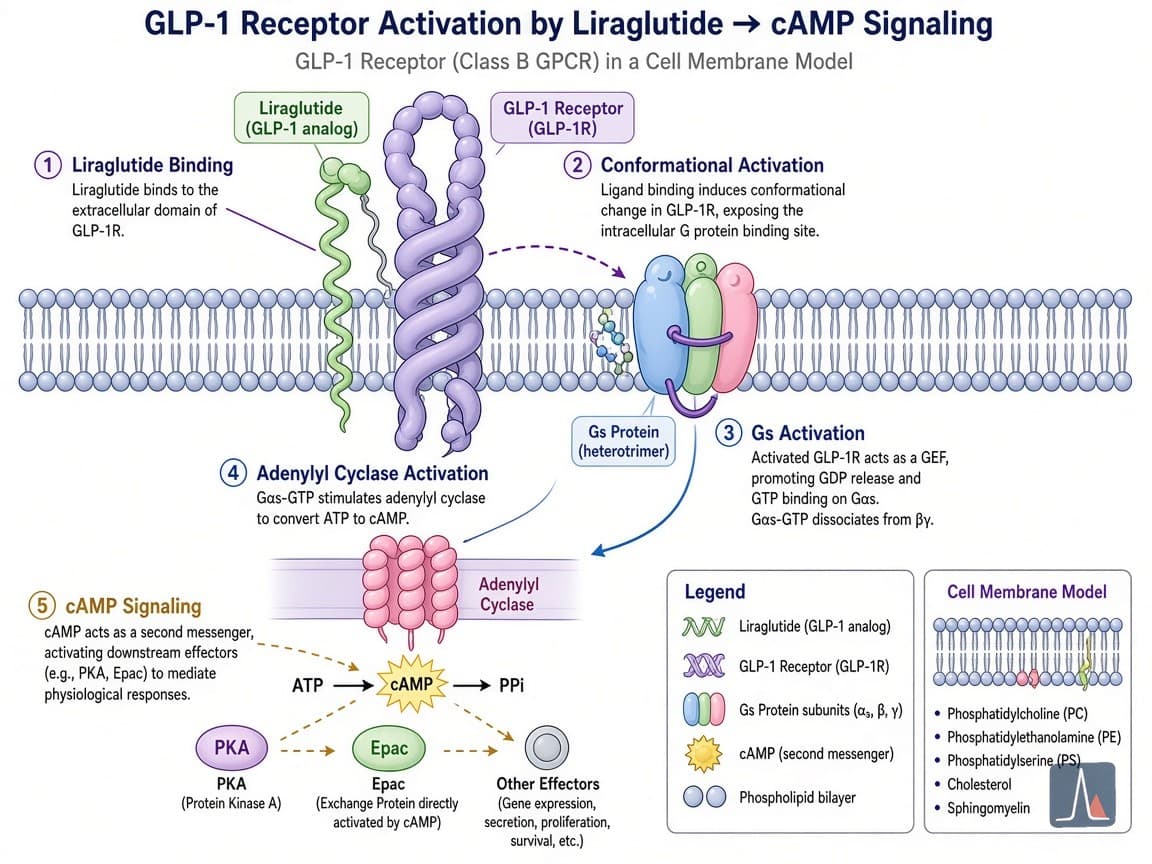
Liraglutide originated from structure-activity programs aimed at extending the ultra-short half-life of native GLP-1 (~1.5–2 min IV, ~1.5 h SC). Systematic variation of fatty-acid chain length (C12–C20), spacer chemistry, and acylation position identified the Lys26(γ-Glu-palmitoyl), Arg34 combination as optimal for balancing receptor potency, albumin affinity, and once-daily suitability. In vitro, liraglutide is a full agonist at the human GLP-1R, stimulating cAMP accumulation with pEC50 values typically reported around 10.2–10.5 in recombinant cell systems. It retains glucose-dependent insulinotropic and glucagon-suppressive effects while slowing gastric emptying in functional assays. Partial intrinsic DPP-4 resistance (despite the native N-terminus) further contributes to its profile. These mechanistic data derive from standardized recombinant and primary cell systems, all performed on the identical defined molecule now catalogued. Limitations include that many early assays used overexpressed receptors and may not fully recapitulate native tissue expression or heterodimerization with other GPCRs. (Review, method; Knudsen & Lau, 2019). 1 2
Preclinical Animal Models
Rodent and nonhuman primate models established liraglutide's effects on appetite, body weight, glycemic control, and organ protection. In diet-induced obese mice and rats, it reduced food intake, promoted weight loss (primarily fat mass), and improved insulin sensitivity. Beta-cell preservation and anti-inflammatory effects were observed in diabetic models. Nonhuman primate studies confirmed translation of weight loss and metabolic improvements. However, chronic dosing in rodents and mice produced dose- and duration-dependent thyroid C-cell hyperplasia, adenomas, and carcinomas; these findings prompted class boxed warnings although human relevance remains unproven and incidence of medullary thyroid cancer has not clearly increased in post-marketing surveillance. Renal and cardiovascular protective signals were also noted in disease models. Limitations of these studies include high doses relative to human exposure, species differences in GLP-1R expression (particularly in thyroid C-cells), and predominant use of young, male animals. (Animal papers, 2000–2020s).
Human Randomised Trial Evidence
Large industry-sponsored programmes generated the core clinical dataset. The LEAD programme (multiple phase 3 RCTs, ~2006–2012) demonstrated liraglutide (1.2–1.8 mg) produced HbA1c reductions of ~1.0–1.5% versus comparators or placebo in type 2 diabetes, often accompanied by 2–4 kg weight loss and modest blood pressure improvements. The SCALE programme (including the 3731-participant SCALE Obesity and Prediabetes trial) showed 3.0 mg liraglutide produced mean weight loss of 8.4 kg versus 2.8 kg with placebo at 56 weeks (difference –5.6 kg), with higher proportions achieving ≥5% and ≥10% loss; it also delayed progression to diabetes in prediabetic individuals. The LEADER cardiovascular outcomes trial (9340 patients with type 2 diabetes, median 3.8 years) reported a 13% relative reduction in 3-point major adverse cardiovascular events (13.0% vs 14.9%; HR 0.87, 95% CI 0.78–0.97), with lower cardiovascular and all-cause mortality. Meta-analyses of RCTs confirm consistent weight loss (~4.8% additional vs placebo at 3.0 mg) but higher rates of gastrointestinal adverse events (nausea, vomiting, diarrhea) leading to discontinuation, and increased reporting of gallbladder-related events. Some pharmacovigilance analyses have identified disproportionality signals for pancreatitis and, less consistently, psychiatric events, although causality is not established and event rates in controlled trials were low. Post-discontinuation weight regain is well-documented. Limitations across the dataset include predominant industry sponsorship, relatively short duration for some metabolic endpoints, under-representation of certain ethnic groups or very elderly patients, and the fact that all pivotal data were generated with specific pharmaceutical formulations; research-grade material may differ in purity or excipients. (Clinical and meta-analysis papers, 2006–2026). 3 4
Safety Profile, Comparative Context, and Evidence Syntheses
Common adverse events are gastrointestinal and generally transient; serious events include rare pancreatitis and gallbladder disease. The rodent thyroid C-cell signal led to contraindications in patients with personal/family history of medullary thyroid carcinoma or MEN2. Cardiovascular safety is reassuring from LEADER, but head-to-head data with newer agents (semaglutide, tirzepatide) show liraglutide produces modestly smaller weight loss. Real-world evidence and systematic reviews (2015–2026) affirm benefits in appropriate populations but highlight tolerability as a key limitation to long-term adherence. No human data exist specifically on gray-market or compounded research liraglutide; identity, purity, sterility, and batch-to-batch consistency must be verified independently. Recent syntheses also explore potential applications in neurodegenerative conditions, although evidence remains preliminary.
Why Tracked as a Single Compound Entry: Catalog Rationale
The open catalog's design prioritizes chemical precision. Liraglutide exemplifies a molecule whose identity is fully captured by one structure: a fixed amino-acid sequence plus one defined side-chain modification. All discovery chemistry, biophysical characterization, preclinical models, pivotal RCTs, regulatory filings, and post-marketing reports refer to this entity. Maintaining a single page consolidates access to this literature, supports accurate scientific illustration of the acylated lysine and arginine substitution, and enables clear differentiation from catalogued items that are intentionally multi-component or less well-defined. Researchers using the liraglutide entry can confidently reference the molecule whose properties (receptor potency, albumin binding, half-life, immunogenicity profile) have been characterised across thousands of publications. This approach promotes reproducibility in laboratory peptide work while acknowledging that research-grade material is not identical to approved pharmaceutical products.
In summary, liraglutide's catalog presence rests on its status as one chemically discrete, well-characterised research tool with a rich but bounded evidence base. Its single-entry status reflects sound catalog logic: one molecule, one record, clear linkage to primary literature. Users should verify the identity and quality of any supplied material through orthogonal analytical methods before laboratory use.
Sources
- Knudsen LB, Lau J. The Discovery and Development of Liraglutide and Semaglutide. Front Endocrinol (Lausanne). 2019;10:155. doi:10.3389/fendo.2019.00155. PMID: 31031702. (Review of discovery chemistry and pharmacology). 1
- Pi-Sunyer X, et al. A Randomized, Controlled Trial of 3.0 mg of Liraglutide in Weight Management. N Engl J Med. 2015;373(1):11-22. doi:10.1056/NEJMoa1411892. PMID: 26132939. (SCALE Obesity and Prediabetes RCT). 3
- Marso SP, et al; LEADER Steering Committee. Liraglutide and Cardiovascular Outcomes in Type 2 Diabetes. N Engl J Med. 2016;375(4):311-322. doi:10.1056/NEJMoa1603827. PMID: 27295427. (LEADER CVOT). 4
- PubChem CID 16134956; ChEBI 71193; Wikipep structural entry (sequence, modifications, biophysical data).
- Multiple 2022–2026 meta-analyses of weight loss, safety, and comparative effectiveness (various journals, including Expert Rev Clin Pharmacol, Cochrane Database Syst Rev).
Recurrent limitations noted in syntheses include industry sponsorship of pivotal trials, variable duration of follow-up, and the gap between pharmaceutical-grade product data and unverified research-grade peptides. Null or unfavorable findings (thyroid C-cell tumors in rodents, higher GI adverse-event rates, post-treatment weight regain) are reported alongside favorable outcomes.
More briefings
- Survodutide Dual Agonist: Preclinical and Clinical EvidenceThe open-catalog entry for survodutide describes a synthetic acylated 29-amino-acid peptide dual agonist of glucagon and GLP-1 receptors supplied as high-purity lyophilized powder for laboratory metabolic research. Randomised trials report
- Dulaglutide: GLP-1 Receptor Agonist in Metabolic CareDulaglutide is a recombinant Fc-fusion GLP-1 receptor agonist engineered for once-weekly administration in laboratory and clinical metabolic research. Randomised trials report glycaemic improvements, cardiovascular risk reduction and modest
- Cagrilintide-Semaglutide Mixture: Open-Catalog Context and Metabolic Trial EvidenceThe open-catalog cagrilintide-semaglutide mixture supplies a research pairing of an amylin receptor agonist and GLP-1 receptor agonist for laboratory metabolic studies. Randomised trials of co-administration report enhanced weight loss (13–
All information and products discussed are for laboratory and research use only. Not for human or veterinary use. Not intended to diagnose, treat, cure, or prevent any disease.