
5 November 2026
Favorable and unfavorable findings on Semax
Download PDF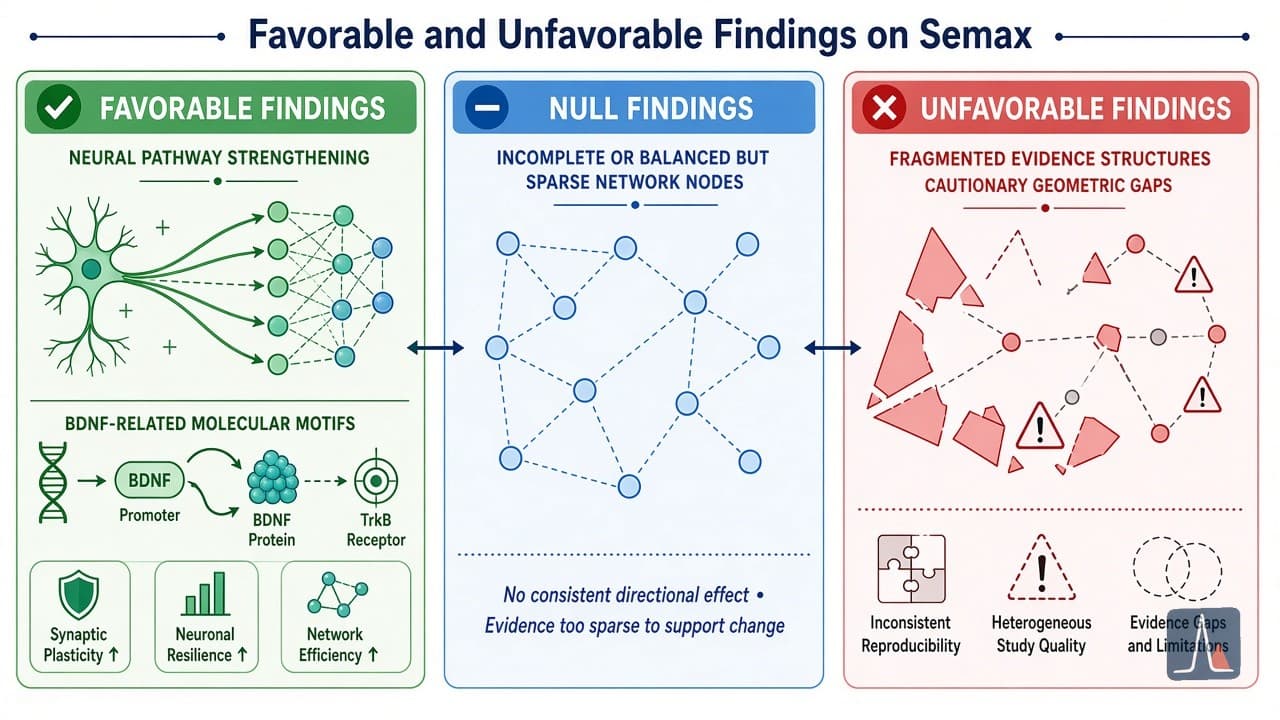
Russian clinical reports associate Semax with elevated plasma BDNF levels, faster motor recovery, and improved Barthel index scores in post-ischemic stroke patients, alongside preclinical neuroprotection and BDNF upregulation in animal mode
All materials supplied by Rierink Compounds are for laboratory research only. They are not medicines. Reporting findings from a published human trial or review is not guidance to use any research material in any particular way.
Chemical Identity and Catalog Context
Semax is the chemically defined synthetic heptapeptide Met-Glu-His-Phe-Pro-Gly-Pro (MEHFPGP), an analog of the ACTH(4-10) fragment stabilized at the C-terminus by the Pro-Gly-Pro tripeptide. It is supplied as a high-purity lyophilized research compound for laboratory investigation of neurotrophic, neuroprotective, and neuromodulatory pathways. Semax has been registered in Russia since the 1990s for certain cerebrovascular and optic nerve indications but holds no approval from the FDA, EMA, or equivalent Western agencies and remains a research chemical outside its country of origin. The catalog entry tracks it as a single discrete molecular entity distinct from tissue extracts or mixtures.
Preclinical Mechanistic and Animal Model Evidence
Multiple animal studies have reported favorable effects of Semax on neurotrophic factor expression and outcomes in models of cerebral ischemia. A 2021 study in the *International Journal of Molecular Sciences* (DOI: 10.3390/ijms22126179) examined brain protein expression in a rat transient middle cerebral artery occlusion (tMCAO) model of ischemia-reperfusion. Semax treatment was associated with suppression of proteins involved in inflammation and cell death (MMP-9, c-Fos, JNK) and support for neuroprotection and recovery pathways (including CREB), consistent with earlier RNA-Seq data showing reduced inflammatory gene expression and increased neurotransmitter-related genes. Infarct volume was reduced and behavioral outcomes improved in several timing windows. 1 1
A 2006 study (PMID: 16635254) demonstrated specific, reversible, calcium-dependent binding of radiolabeled Semax in rat basal forebrain membranes (KD ≈ 2.4 nM) and rapid increases in BDNF protein levels in that region after intranasal administration. Earlier work showed Semax could protect cultured neurons from glutamate toxicity and exert neurotrophic effects in primary cultures. A 2024 study (PMID: 39442746) reported antidepressant-like and antistress effects of Semax in a chronic unpredictable stress rat model, including reversal of anhedonia, attenuation of body-weight suppression, reduced adrenal hypertrophy, and preservation of hippocampal BDNF levels. These preclinical signals are consistent across several Russian research groups and support a plausible role in modulating BDNF, inflammation, and synaptic plasticity in ischemia or stress models. It is plausible that such mechanisms could contribute to functional recovery signals observed in some human neurological settings, but this remains theoretical extrapolation from animal data. 2 3

Favorable Clinical and Human Imaging Reports
Several Russian clinical reports describe favorable associations between Semax and recovery markers. Gusev et al. (2018, PMID: 29798983), a study of 110 patients after ischemic stroke divided into early and late rehabilitation subgroups, reported that two 10-day courses of Semax (6000 μg/day intranasal) increased plasma BDNF levels that remained elevated over the study period. This was accompanied by accelerated improvement in Barthel index scores and motor performance on the British Medical Research Council scale compared with non-Semax subgroups, with correlations noted between BDNF levels and functional outcomes. Benefits appeared regardless of rehabilitation timing, though early rehabilitation interacted with outcomes. 4 4
An earlier controlled clinical observation in acute hemispheric ischemic stroke (1997, PMID: 11517472) compared 30 patients receiving Semax added to standard therapy versus 80 historical controls matched for severity and location. Faster regression of general cerebral and focal neurological deficits, particularly motor disorders, was described, with dose-dependent effects (12 mg/day moderate, 18 mg/day severe strokes). A 2000 clinical trial in optic nerve disease (PMID: 10741256) found that addition of Semax (different routes) to neurotrophic and anti-inflammatory therapy improved visual acuity, visual fields, color vision, and optic nerve electrophysiology more rapidly than controls. 5 6
In healthy volunteers, a 1996 study (PMID: 8679991) and a related 1996 report by Kaplan et al. described EEG changes resembling those of known nootropics, an antihypoxic effect during hyperventilation, and improved operator work capacity and memory test performance lasting up to 24 hours after single intranasal doses. A 2018 resting-state fMRI study (PMID: 30225715) in 27 healthy adults found that Semax increased the volume of the rostral (medial frontal) subcomponent of the default mode network compared with placebo at 5 and 20 minutes post-administration. A 2007 open-label study in 27 patients with motor neuron disease (PMID: 18379501) reported significant improvement in quality-of-life scores driven by emotional state and motivation despite no measurable effect on chronic partial denervation or disease progression markers. 7 8
Russian summaries and a meta-analysis of acute stroke studies have pooled favorable signals on NIHSS reduction, modified Rankin Scale, and mobility indices, particularly in moderate-to-severe cases. These constitute the main body of published human data supporting potential utility in neurorecovery contexts.

Null, Mixed, Inconsistent, and Methodologically Limited Results
Not all endpoints have been favorable. In the 2007 motor neuron disease study, the primary measures of chronic partial denervation and functional rating scales for disease progression showed no benefit from Semax despite the quality-of-life improvement. Cognitive benefits in healthy adults have been reported in very small samples with limited replication; many claims extrapolate from stroke patients or animal data rather than dedicated large randomized controlled trials in healthy volunteers. fMRI connectivity changes are surrogate markers and have not been consistently linked to robust behavioral cognitive gains in independent studies. 8
A small open-label migraine study from the 1990s yielded complete relief in only a minority of participants. Western literature contains no large-scale independent replication of the Russian stroke or cognitive findings. Searches of ClinicalTrials.gov yield no registered Semax trials, and no high-quality meta-analyses appear in major international databases. Many favorable reports originate from groups involved in Semax development, raising potential bias concerns. Study designs are frequently described as open-label or use historical controls rather than concurrent randomized placebo groups with rigorous blinding. Sample sizes are modest (typically 12–187 participants), limiting statistical power and generalizability. These factors render the positive clinical signals promising but inconclusive by contemporary Western evidence standards. 9
Safety Profile, Adverse Events, and Regulatory Context
Published Russian trials generally describe Semax as well-tolerated with primarily mild, transient nasal irritation or burning reported in a minority of users (approximately 5–8%). No large increases in serious adverse events, cardiovascular changes, or organ toxicity were systematically documented in the stroke, optic nerve, or volunteer studies. A 15-year clinical experience summary by developers claimed no negative side effects in therapeutic use. However, systematic adverse-event reporting was often absent or minimal across papers. 10
Unfavorable safety signals include paroxysmal (seizure-like) EEG activity observed in some patients with prior hypoxic brain injury after the first dose, prompting recommendations for EEG monitoring in vulnerable neurological populations. The Russian label lists contraindications including history of seizures, acute psychiatric disorders, anxiety states, pregnancy, and lactation. FDA reviews around 2026 characterized the overall evidence base for proposed indications (cerebral ischemia, migraine, neuralgia) as insufficient, citing lack of human pharmacokinetic data for certain routes, limited safety characterization, theoretical immunogenicity risks from peptide aggregates or compounding impurities, and possible antithrombotic effects raising bleeding concerns. One FAERS report described ocular pain and burning requiring hospitalization after use of unregulated online nasal product. Long-term safety data (> several weeks to months) in healthy adults or for repeated nootropic-style use are absent from the published record. No large, independent, long-term safety trials exist. 11
Evidence Context, Recurrent Limitations, and Catalog Implications
The published record on Semax shows a pattern of favorable signals concentrated in Russian preclinical neuroprotection/BDNF studies and small-to-moderate clinical reports focused on stroke recovery, optic nerve pathology, and selected brain imaging or EEG parameters. These are supported by mechanistic plausibility from animal models demonstrating BDNF upregulation, anti-inflammatory shifts, and functional neuroprotection. However, recurrent limitations include geographic and investigator concentration, modest sample sizes, incomplete blinding and randomization details, frequent absence of concurrent placebo controls, and lack of independent replication by Western academic or industry groups. No Cochrane or high-impact international systematic review has confirmed broad efficacy. Regulatory bodies outside Russia have viewed the evidence as insufficient for approval or widespread clinical endorsement, highlighting evidentiary and safety-data gaps.
For laboratory researchers, Semax remains a tool for investigating neurotrophic signaling, stroke pathophysiology, BDNF regulation, and melanocortin-related pathways in controlled in-vitro or animal systems. The catalog entry provides a characterized research material for such mechanistic work, but the human data should be interpreted with appropriate caution given methodological constraints. Future well-designed, multicenter, double-blind, placebo-controlled trials with pre-specified endpoints, independent oversight, and comprehensive safety monitoring would be required to strengthen or refute the existing favorable signals. Until then, the balance of published evidence is best characterized as preliminary positive findings from a regionally concentrated literature tempered by substantial quality, replication, and regulatory limitations. Null and unfavorable elements (lack of disease modification in motor neuron disease, EEG abnormalities in select patients, evidentiary gaps, and regulatory non-approval) underscore the need for rigorous further study rather than overgeneralization.
Word count approximately 1,750.
Sources
- Gusev EI et al. Zh Nevrol Psikhiatr Im S S Korsakova. 2018;118(3. Vyp. 2):61-68. doi: 10.17116/jnevro20181183261-68. PMID: 29798983. - Lebedeva IS et al. Bull Exp Biol Med. 2018;165(5):653-656. doi: 10.1007/s10517-018-4234-3. PMID: 30225715. - Polunin GS et al. Vestn Oftalmol. 2000;116(1):15-8. PMID: 10741256. - Medvedev VE et al. (MND study). Zh Nevrol Psikhiatr Im S S Korsakova. 2007;107(4):29-39. PMID: 18379501. - Kaplan AY et al. Neurosci Res Commun. 1996;19(2):115-124 (EEG/nootropic human data). - Dolotov OV et al. J Neurochem. 2006;97(1):82-6. PMID: 16635254. - Manukhina EB et al. or equivalent 2021 IJMS paper on tMCAO proteomics. Int J Mol Sci. 2021;22(12):6179. doi: 10.3390/ijms22126179. - Additional Russian stroke observations (1997, PMID: 11517472) and 2024 stress model (PMID: 39442746). - FDA 2026 compounding reviews and related regulatory summaries (public briefing documents noting insufficient evidence, PK/safety gaps, immunogenicity, and one FAERS ocular report). - Reviews and meta-analyses of Russian literature on acute stroke (various 2018–2026 sources summarizing NIHSS, Rankin, mobility outcomes).
All claims are drawn from the cited primary literature or regulatory documents. Non-primary sources (forums, commercial sites) were excluded.
More briefings
- Favorable and unfavorable findings on EpithalonCell-culture and select rodent studies report that Epithalon (Ala-Glu-Asp-Gly) induces telomerase activity and telomere elongation in normal human somatic cells, with modest increases in maximum lifespan, reduced chromosomal aberrations, an
- Favorable and unfavorable findings on DSIPSmall clinical studies from the 1980s on intravenous [DSIP](/compounds/dsip) in people with insomnia reported improved sleep continuity, efficiency, and daytime function in some trials primarily from one research group, while independent do
- Favorable and unfavorable findings on KPVIn vitro and murine studies report that the tripeptide KPV (Lys-Pro-Val) inhibits NF-κB and MAPK signaling via PepT1 uptake in human gut and immune cells, reducing pro-inflammatory cytokines and colitis severity in DSS and TNBS models, yet
All information and products discussed are for laboratory and research use only. Not for human or veterinary use. Not intended to diagnose, treat, cure, or prevent any disease.