
8 November 2026
Favorable and unfavorable findings on Dulaglutide
Download PDF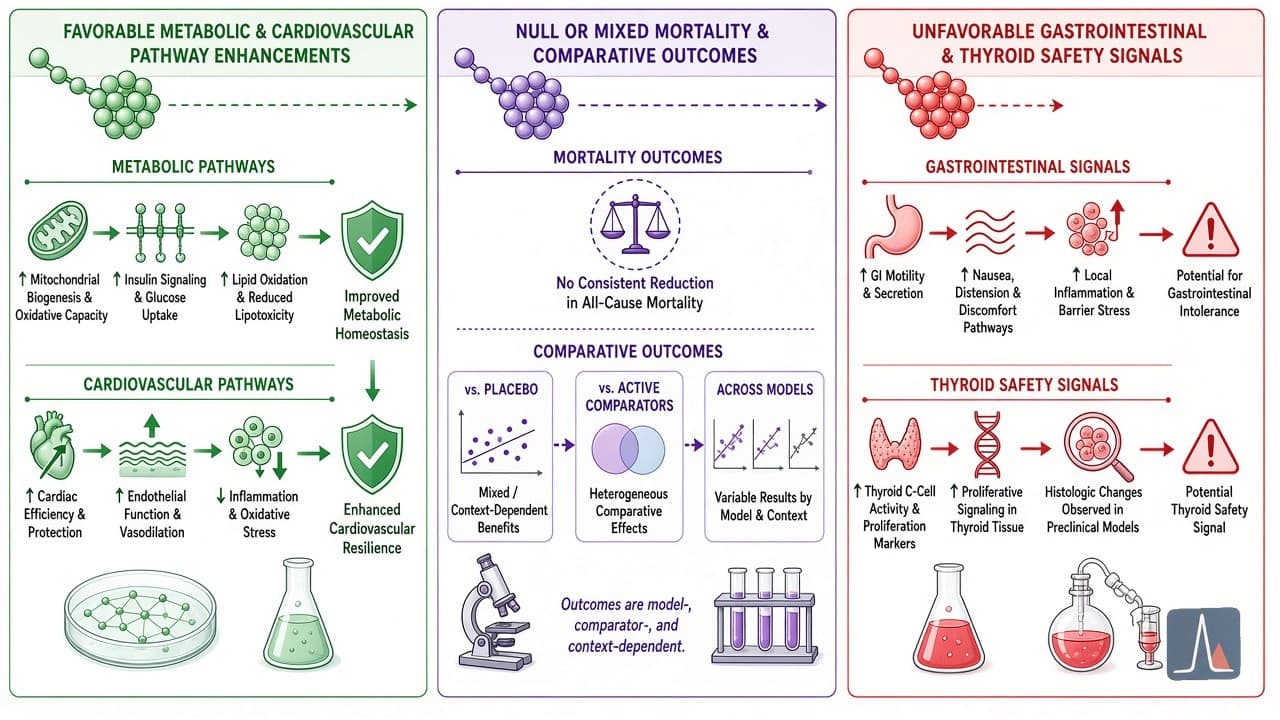
Published randomised trials and meta-analyses report that dulaglutide improves glycaemic control, produces modest weight reduction, and lowers major adverse cardiovascular event risk in adults with type 2 diabetes, while also being linked t
Favorable and unfavorable findings on Dulaglutide
Dulaglutide is a recombinant Fc-fusion GLP-1 receptor agonist supplied as a high-purity research compound for laboratory metabolic studies. All materials listed in the Rierink catalog are for laboratory research only and are not medicines. Reporting what published human studies, trials, or reviews found does not constitute guidance to use the research material in people or animals.
Chemical Identity and Catalog Context
Dulaglutide is catalogued at /compounds/dulaglutide as a single defined research molecule for in vitro, ex vivo, and preclinical metabolic investigations. It belongs to the GLP-1 receptor agonist class, sharing mechanistic overlap with compounds such as semaglutide, liraglutide, and tirzepatide. Indexed literature by late 2026 includes thousands of records spanning receptor pharmacology, the AWARD glycaemic programme, the REWIND cardiovascular outcomes trial, comparative network meta-analyses, and safety syntheses. The current briefing focuses exclusively on separating favorable, null/mixed, and unfavorable reported findings while noting recurrent methodological patterns such as industry sponsorship, varying background therapies, and the evolution of comparative data against newer multi-agonists.
Favorable Reported Findings from Randomised Trials and Meta-Analyses
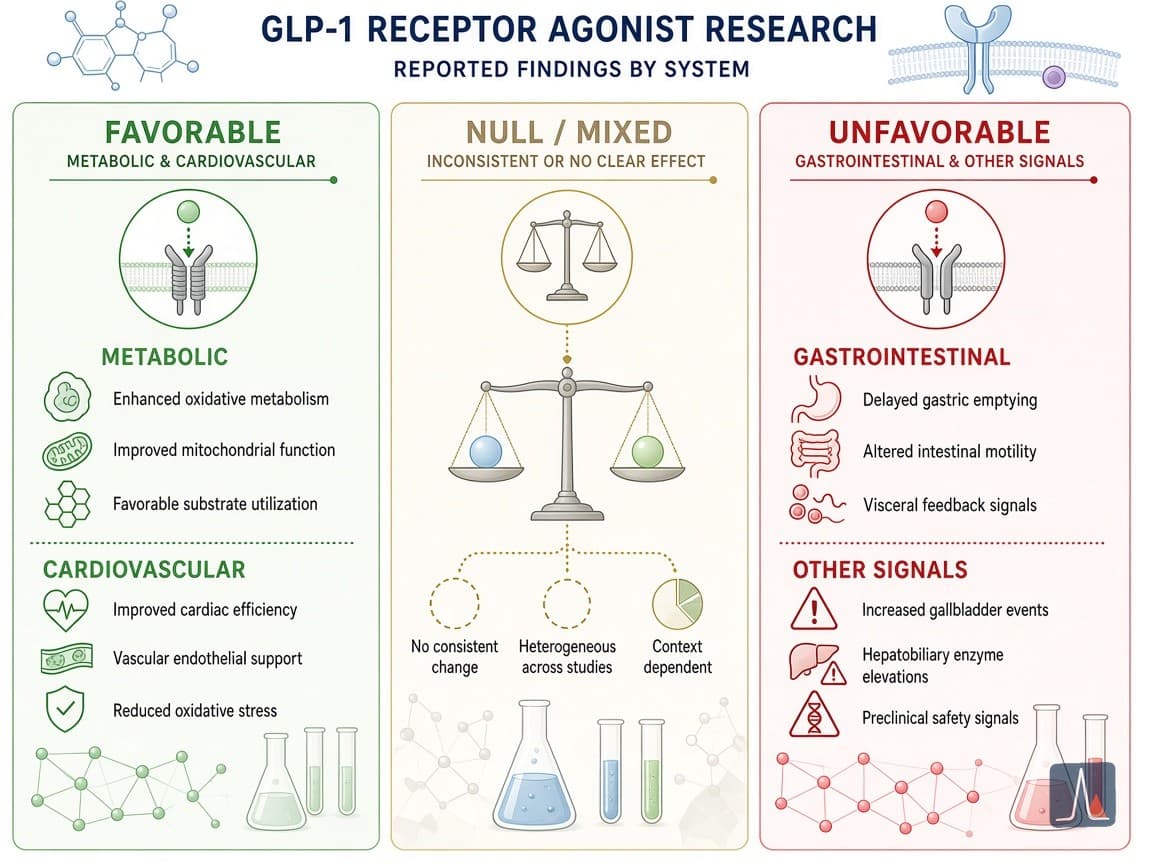
Multiple meta-analyses of randomised controlled trials have reported statistically significant reductions in HbA1c and increases in the proportion of participants reaching glycaemic targets with dulaglutide versus placebo or active comparators. These effects were observed both as monotherapy and as add-on therapy. Systematic reviews also describe modest reductions in body weight, BMI, and waist circumference, with greater magnitude at higher tested exposures and longer durations. Lower rates of hypoglycaemia compared with insulin or sulfonylurea-containing regimens appear in several pooled analyses.
The large REWIND trial (double-blind, placebo-controlled, n=9901, median follow-up 5.4 years) reported a reduction in the composite of cardiovascular death, non-fatal myocardial infarction, or non-fatal stroke. Benefits were described as consistent in participants with and without established cardiovascular disease. Post-hoc analyses of the same dataset reported reductions in total (first plus recurrent) cardiovascular or fatal events and in certain renal and microvascular composites. Umbrella reviews and network meta-analyses up to 2026 have positioned dulaglutide among agents associated with cardiovascular and renal risk reduction within the GLP-1 receptor agonist class. A 2026 systematic review and meta-analysis of randomised trials in overweight or obese adults with type 2 diabetes found small, statistically significant increases in serum amylase and lipase that remained well below thresholds typically associated with clinical pancreatitis, supporting an interpretation of overall pancreatic safety in the studied populations.
Preclinical animal models have reported improvements in glucose homeostasis, insulin sensitivity, and body-weight regulation in diabetic and obese rodent strains, along with certain neuroprotective or anti-inflammatory signals in selected stress models. In vitro records characterise potent, glucose-dependent insulinotropic and glucagon-suppressive activity at the GLP-1 receptor.

Unfavorable Reported Findings on Tolerability and Safety
Randomised trials and meta-analyses consistently report higher rates of gastrointestinal adverse events (nausea, vomiting, diarrhoea, abdominal pain) with dulaglutide than with placebo or certain active controls. In the REWIND trial, nearly half of participants assigned to dulaglutide experienced gastrointestinal events compared with approximately one-third on placebo; these events were the most common reason for discontinuation in many studies. Real-world pharmacovigilance databases contain large numbers of reports dominated by gastrointestinal, dehydration-related, and acute kidney injury signals, although causality assessment remains complex.
Chronic toxicity and carcinogenicity studies in rats demonstrated dose- and duration-dependent increases in thyroid C-cell hyperplasia, adenomas, and carcinomas. Although human relevance remains undetermined and clinical trial incidence of medullary thyroid carcinoma has been low, regulatory labelling includes a boxed warning and contraindication in individuals with personal or family history of medullary thyroid carcinoma or multiple endocrine neoplasia syndrome type 2. Modest elevations in pancreatic enzymes have been observed across trials; while a 2026 meta-analysis concluded these changes are unlikely to translate into increased clinical pancreatitis, the class carries warnings for acute and severe pancreatitis, and rare post-marketing cases continue to be reported.
Network meta-analyses published 2024–2026 frequently rank dulaglutide below semaglutide, tirzepatide, and emerging triple agonists for magnitude of weight loss and, in some analyses, glycaemic efficacy. Higher rates of adverse-event withdrawal compared with placebo or selected comparators appear recurrently. Comparative data therefore characterise dulaglutide as less potent on anthropometric outcomes than newer multi-receptor agonists available in the catalog.

Null, Mixed, Inconsistent, and Context-Dependent Results
The REWIND trial did not demonstrate a statistically significant reduction in all-cause mortality or cardiovascular death. Effects on individual components of the primary cardiovascular composite were not uniform, with stroke reduction more prominent than myocardial infarction reduction in primary reports. Heart-failure hospitalisation data have been neutral or underpowered in primary analyses.
Weight-loss magnitude is consistently described as modest relative to dual or triple agonists; several head-to-head or network comparisons show statistically significant advantages for semaglutide or tirzepatide on body-weight endpoints. Heterogeneity is high in many meta-analyses, driven by differences in background therapy, disease duration, baseline BMI, and trial duration. Preclinical anti-inflammatory effects have been inconsistent: some rodent inflammation models reported limited or null independent anti-inflammatory activity beyond metabolic improvements.
Pancreatic histology in non-human primate studies at very high exposures showed no evidence of pancreatitis, necrosis, or preneoplastic changes, contrasting with mild exocrine alterations observed in certain diabetic rat models. Human thyroid-cancer signals remain inconclusive; while rodent data triggered regulatory warnings, large cardiovascular outcomes programmes and observational syntheses have not shown clear increases in medullary thyroid carcinoma incidence. Enzyme elevations appear more pronounced with shorter treatment durations and higher BMI, yet clinical pancreatitis rates have not risen correspondingly in most pooled analyses.

Evidence Syntheses, Recurrent Limitations, and Catalog Implications
Systematic reviews, network meta-analyses, and umbrella reviews synthesise a large evidence base but share limitations: predominant industry funding, open-label glycaemic trials, variable background therapies, and shorter durations relative to lifetime risk. Comparative effectiveness data published after 2023 increasingly highlight the superior weight-loss performance of newer agents such as semaglutide, tirzepatide, and retatrutide, positioning dulaglutide as a well-characterised but less potent single GLP-1 receptor agonist benchmark. Real-world persistence is often limited by gastrointestinal tolerability.
For laboratory researchers, the extensive indexed record on dulaglutide provides a robust reference for receptor pharmacology, metabolic signalling, and comparative incretin biology. The compound remains valuable for mechanistic studies, head-to-head receptor activation experiments, or as a positive control in metabolic assays. However, catalog users should interpret human efficacy and safety data within the constraints of the studied populations (primarily adults with type 2 diabetes) and recognise that favourable cardiovascular and glycaemic signals coexist with clear tolerability drawbacks and comparative inferiority on weight reduction versus newer multi-agonists. Null or mixed mortality and heart-failure data further underscore the importance of nuanced, evidence-based interpretation rather than uniform benefit assumptions.
Recurrent themes include dose- and duration-dependence of both efficacy and adverse events, the transient nature of many gastrointestinal symptoms after initiation, and the gap between biochemical enzyme changes and clinical pancreatitis. Future laboratory work may usefully explore receptor trafficking, biased signalling, or combination effects with catalogued agents such as cagrilintide or other metabolic peptides.
Sources
- Gerstein HC, et al. Dulaglutide and cardiovascular outcomes in type 2 diabetes (REWIND): a double-blind, randomised, placebo-controlled trial. *Lancet*. 2019. DOI: 10.1016/S0140-6736(19)31149-3.
- Zhang L, et al. Efficacy and safety of dulaglutide in patients with type 2 diabetes: a meta-analysis and systematic review. *Sci Rep*. 2016. DOI: 10.1038/srep18904. PMID: 26742577.
- Wang Y, et al. Efficacy and safety of long-acting glucagon-like peptide-1 receptor agonist dulaglutide in patients with type 2 diabetes: a systematic review and meta-analysis of 21 randomized controlled trials. *Endocrine*. 2020. DOI: 10.1007/s12020-020-02193-9. PMID: 31927749.
- Byrd RA, et al. Chronic toxicity and carcinogenicity studies of the long-acting GLP-1 receptor agonist dulaglutide in rodents. *Endocrinology*. 2015. DOI: 10.1210/en.2014-1722. PMID: 25860029.
- 2026 systematic review and meta-analysis on effects of subcutaneous dulaglutide on amylases and lipase (Diabetol Metab Syndr). DOI-linked 2026 records.
- Additional network meta-analyses and umbrella reviews 2024–2026 comparing GLP-1 receptor agonists (various journals indexed in PubMed/Europe PMC).
All cited works were identified via PubMed, Europe PMC, and journal databases. No shop, forum, or non-indexed sources were used. Claims without identifiable DOI, PMID, or journal URL were excluded.
More briefings
- Retatrutide in indexed studiesIndexed records on ClinicalTrials.gov and PubMed characterize [Retatrutide](/compounds/retatrutide) (LY3437943) as the subject of numerous phase 2 and phase 3 randomised, double-blind, placebo-controlled trials reporting dose-dependent body
- Melatonin in indexed studiesIndexed meta-analyses of randomised controlled trials report reduced sleep onset latency and improved sleep quality scores in children and adolescents with neurodevelopmental disorders and selected comorbid conditions, preclinical antioxida
- Semaglutide in indexed studiesSemaglutide appears extensively across indexed scientific literature, with thousands of PubMed entries by late 2026 spanning receptor pharmacology, preclinical metabolic models, large randomised trial programmes (SUSTAIN, PIONEER, STEP, SEL
All information and products discussed are for laboratory and research use only. Not for human or veterinary use. Not intended to diagnose, treat, cure, or prevent any disease.