
21 October 2026
5-Amino-1MQ in preclinical reports: NNMT assays, mouse findings, and no human trial
Download PDF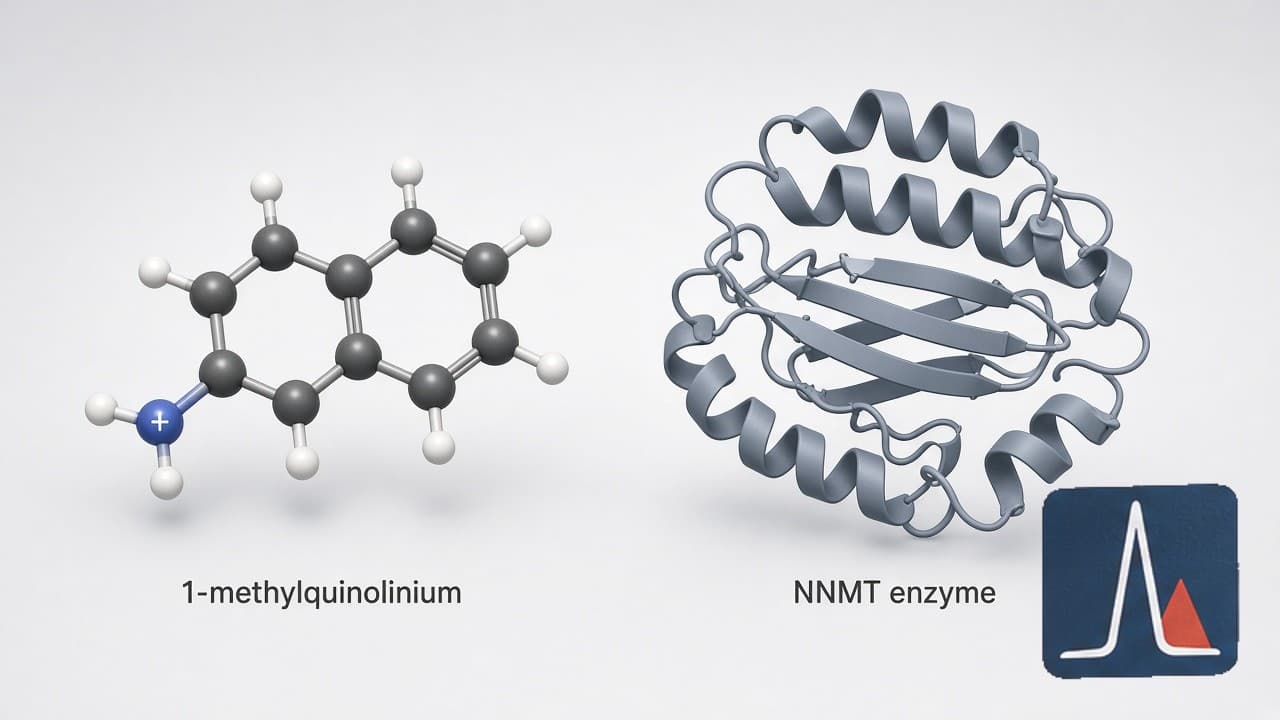
Journal papers report 5-Amino-1MQ as an NNMT inhibitor in cells and in mice. No human trial was identified in this briefing; that gap is not evidence of safety.
A narrower question than whether the vial works
Laboratory readers looking up 5-Amino-1MQ usually meet it as a small-molecule inhibitor of nicotinamide N-methyltransferase (NNMT), not as a peptide and not as a medicine. The chemical name used in the 2018 biochemical paper is 5-amino-1-methylquinolinium. Rierink lists the material for laboratory research only. It is not a medicine. Nothing in this note assigns a therapeutic action to the catalog item, and a favorable line in a mouse paper is not a property of the vial on the shelf.
The question here is narrower than a product claim. What did the retained papers and pages actually report about NNMT inhibition, adipocyte cultures, and mice? What limitation sits on each report? What is missing, especially any human study? Archived notes on this site have covered other research materials. This note does not repeat those briefings.
Two journal records in the research memo carry a DOI. A third item is a news page with a URL but no DOI or PMID. Two further items are editorial websites with URLs and no DOI or PMID. Claims in the memo that lacked a DOI, a PMID, or a URL were dropped. Where a URL points to a non-journal page, that source class is stated with the finding. A secondary page is not upgraded into a clinical result by restating it.
This note does not give doses, reconstitution steps, concentrations, routes, schedules, cycles, or any instruction for giving the material to a person or an animal. It does not advise use.
What “reported” means in this note
Each finding below keeps three labels: study type, the direction of the reported result, and a limitation. Favorable means the authors described a change they treated as consistent with NNMT inhibition or with a model readout they regarded as improved. Null, here, means the search record supplied for this briefing did not return a human trial. It does not mean a trial was run and found no effect. Mixed means the evidence file itself is narrow. Unfavorable efficacy data—experiments in which 5-Amino-1MQ worsened a prespecified endpoint—were not present in the claims retained for this note. That absence is a gap in the file. It is not a demonstration that unfavorable results do not exist in the wider literature.
In theory, a membrane-permeable NNMT inhibitor that shifts the NAD+ and S-adenosylmethionine balance in cultured adipocytes could, if the same enzyme node mattered in human adipose tissue, move related metabolites in people. That sentence is theoretical. It is not a result in people, and it is not a property of the vial on the shelf.
In vitro: membrane-permeable NNMT inhibition
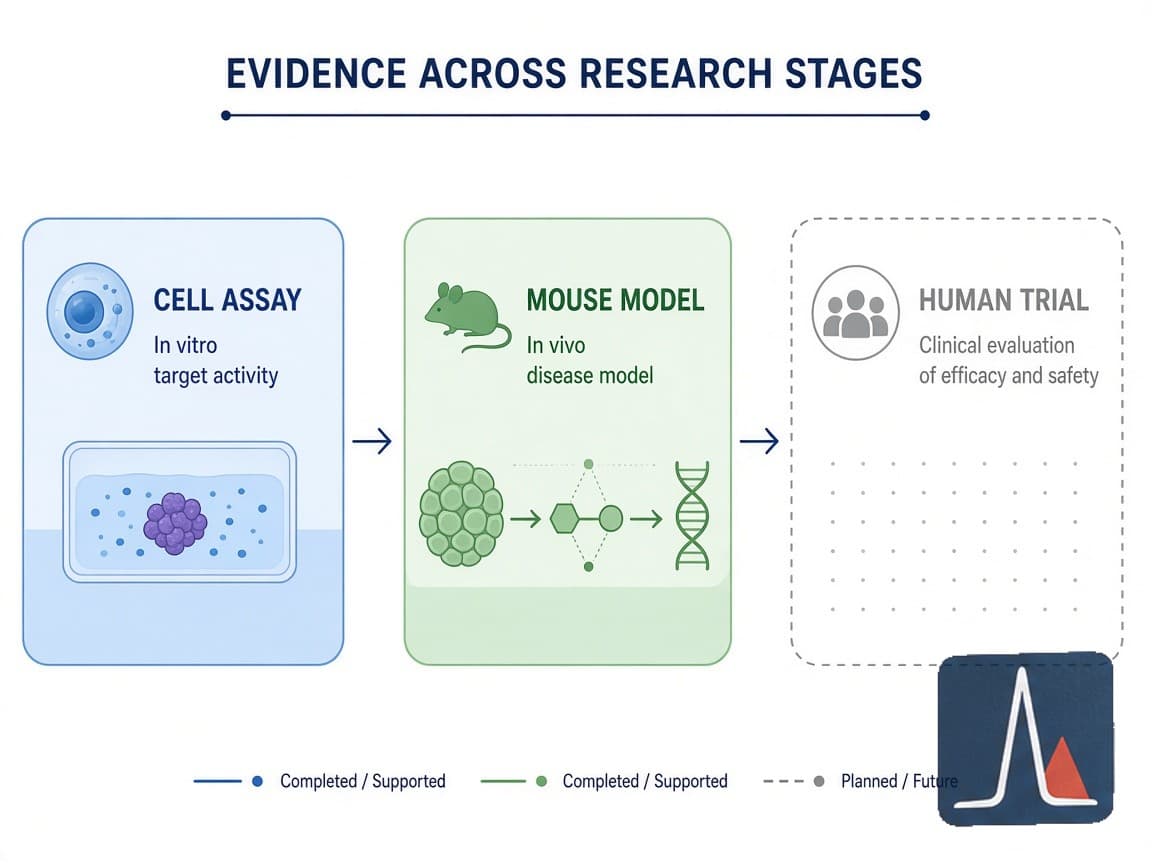
Study type: in vitro, covering a biochemical assay and adipocyte culture. Direction: favorable for target engagement in those systems. Limitation: in-vitro conditions and cell lines do not predict in-vivo pharmacology or any clinical effect.
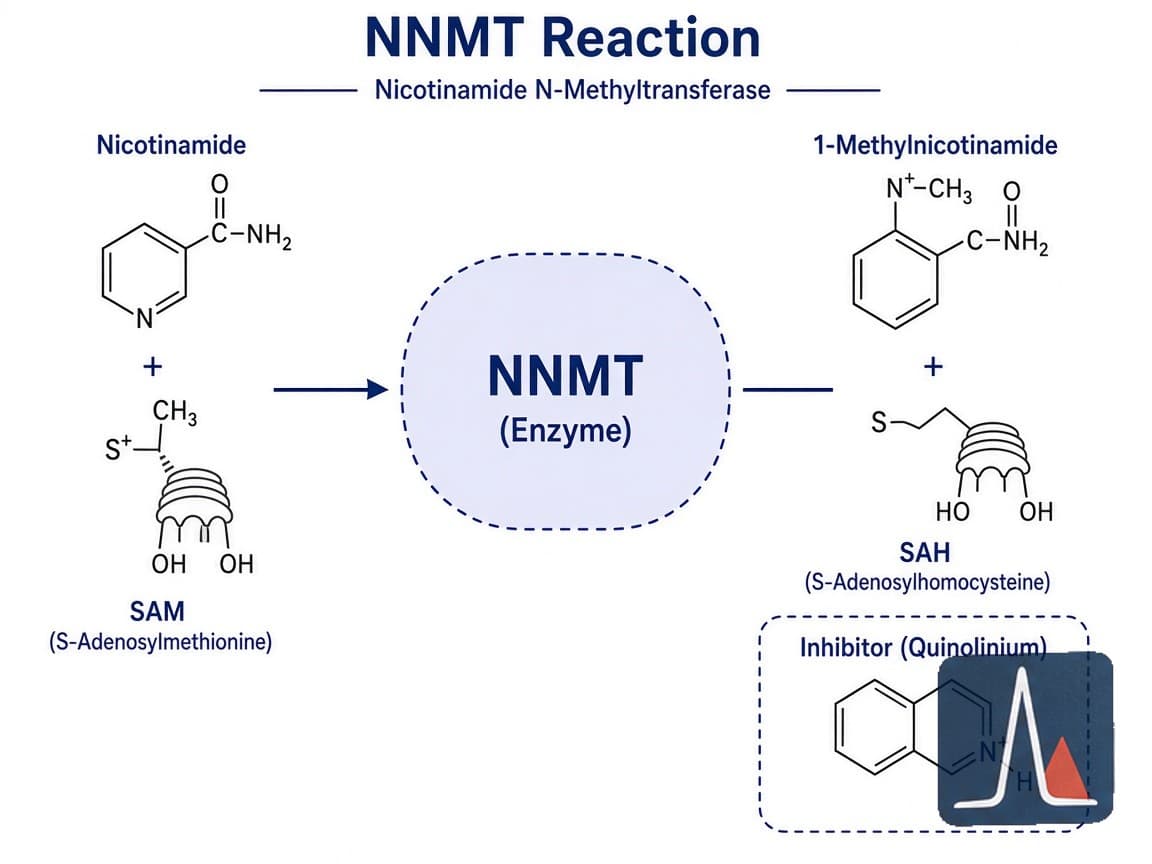
Neelakantan and colleagues, in a 2018 paper in Biochemical Pharmacology (DOI 10.1016/j.bcp.2017.11.007; PMID 29155147), described 5-amino-1-methylquinolinium as a selective, membrane-permeable small-molecule inhibitor of NNMT. In the adipocyte experiments summarized with that paper, the compound reduced intracellular 1-methylnicotinamide (1-MNA) and altered the NAD+ to S-adenosylmethionine (SAM) relationship the authors were tracking. The paper’s title also states that related inhibitors reversed high-fat-diet-induced obesity in mice. That clause is an animal-model claim attached to the same record. It is not a human outcome. The dosing scheme is not repeated here.
NNMT methylates nicotinamide using SAM and releases 1-MNA and S-adenosylhomocysteine. In the logic of these assays, blocking that reaction can leave more nicotinamide available for NAD+ salvage pathways and can change how the cell uses SAM. Those are biochemical observations in the systems tested. They do not establish that a research vial will change NAD+ in a person. They do not establish that the material is safe. NAD+ in this paragraph is the cofactor named in the assays, not a recommendation to combine catalog materials.
The numeric inhibitor potency reported in adipocytes is a concentration from a cell assay. This note omits that figure so it is not read as a working concentration for a laboratory protocol or as a dose. Readers who need the assay parameter should consult the paper rather than a supplier page.
A further limitation is chemical identity across vendors and lots. The 2018 paper characterizes a defined research compound under the conditions of that study. A certificate of analysis on a purchased lot can speak to identity and purity tests that the laboratory chose to run. It does not reproduce the biological experiments, and it does not transfer the paper’s mouse title onto the lot.
Animal model: diet-induced obese mice
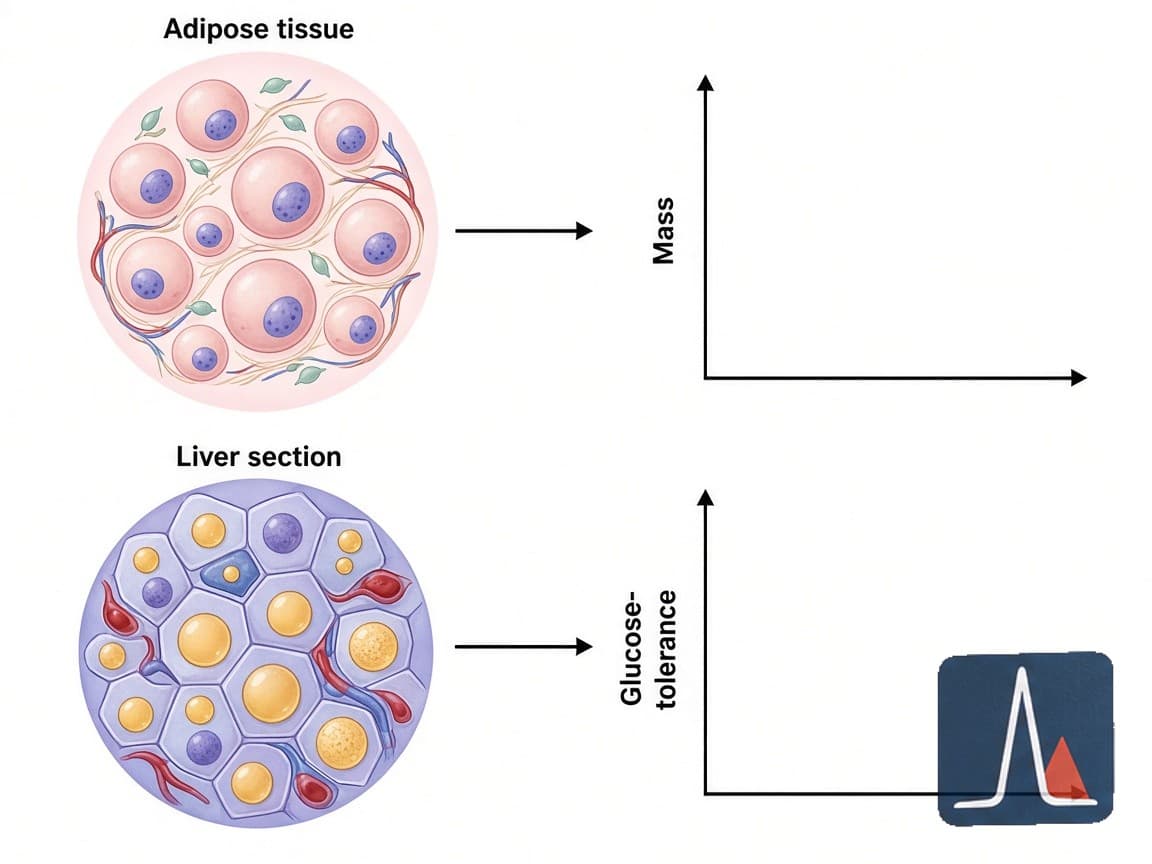
Study type: animal model. Direction: favorable on the metabolic and liver readouts the authors emphasized. Limitation: a preclinical diet-induced obese mouse model, described in this briefing as coming primarily from one research group. Human translation is unknown.
Babula and colleagues, 2024, published “Nicotinamide N-methyltransferase inhibition mitigates obesity-related metabolic dysfunction” (DOI 10.1111/dom.15879). In diet-induced obese mice, the paper reported that 5-Amino-1MQ treatment was associated with smaller gains in body weight and fat mass, improved oral glucose tolerance and insulin sensitivity, suppression of hyperinsulinemia, and attenuation of hepatic steatosis, macrophage infiltration, and liver triglyceride accumulation. The authors described the body-weight and fat-mass pattern as dose-dependent. This note does not restate doses, route, or schedule.
“Oral glucose tolerance” here names a glucose-challenge test used in the mice. It is not an instruction to give the research compound by mouth or by any other route. “Improved” and “attenuated” are the paper’s descriptions of differences against the model controls the authors used. They are not synonyms for a clinical indication.
The title’s verb “mitigates” belongs to the paper’s claim about the mouse model. It is not a statement that the Rierink material treats, prevents, or cures obesity, fatty liver, insulin resistance, or any other condition in people. It is not a statement that the material is safe. Mouse diet, housing, strain, sex distribution, and the control condition all shape these endpoints. A supplier page cannot reconstruct those methods from the citation alone, and it should not be asked to.
No null metabolic arm—for example, a published mouse cohort in which the same endpoints moved against the authors’ hypothesis—was included in the memo. Independent replication by another laboratory was also not documented in the DOI-backed set used here. Both gaps count against treating the 2024 paper as a settled description of the compound. A single favorable animal paper can be real and still be a weak basis for inference outside that model.
Grip strength in aged mice: a secondary page, not a DOI
Study type as given in the memo: animal model. Direction: favorable on forelimb grip strength in that description. Limitation: the citation supplied is a 2024 news page naming Watowich and colleagues (https://www.nmn.com/news/new-insights-on-muscle-strength-the-role-of-inhibiting-an-enzyme-that-hinders-nad-synthesis), without a DOI or PMID in this briefing. A news summary is not a substitute for the methods, statistics, sample size, and conflicts section of a journal article. A preclinical aged-mouse model from one laboratory does not prove a benefit in people.
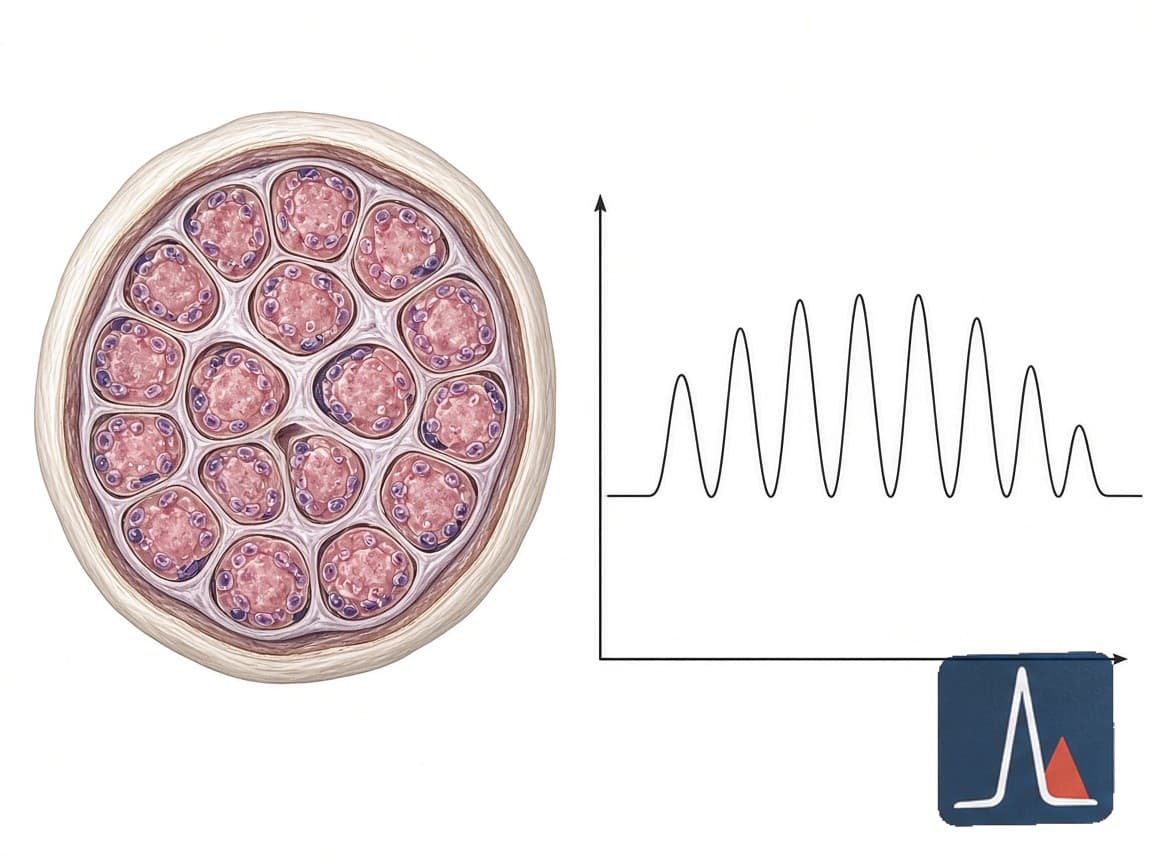
The page, as summarized in the research memo, describes an experiment in 22-month-old mice in which 5-amino-1MQ was associated with higher forelimb grip strength: on the order of a 25 percent increase in sedentary animals and on the order of a 60 percent increase when the compound condition was combined with vigorous exercise, with additional language suggesting a shorter muscle recovery time. Those percentages are outcome descriptions from the secondary page, not dosing figures. Duration of exposure is a schedule and is omitted here. Exercise in that design is a study condition reported by the page. It is not advice to combine the catalog material with training, and this note does not advise any person or animal to use the material.
Because the primary paper is not in the citation set, this briefing cannot confirm sample size, sex, blinding, randomization, or whether the percentages were adjusted for multiple comparisons. Those are material limitations. The finding should be weighted below the two DOI-backed papers until a reader has the journal record in hand. If the journal record disagrees with the news page, the journal record is the one to cite.
In theory, an NNMT inhibitor that raised grip strength in aged mice might suggest a muscle-function hypothesis worth testing, under a protocol a laboratory designs for itself, in an appropriate model. That is theory only. It is not a clinical result, and it is not a property of the material on the shelf.
No human study was identified
Study type: the memo labels a 2026 editorial webpage as a review. Direction: null, in the narrow sense that no trial was found by the search that page is said to represent. Limitation: absence of a registered or published trial does not prove safety and does not prove efficacy. A further limitation is source class.
The page cited for the search statement is an editorial item titled “5-Amino-1MQ: research, side effects and dosage in studies” (Molecular Recovery editorial team, 2026; https://molecularrecovery.com/en/peptides/5-amino-1mq/). It is not a PubMed-indexed systematic review. It has no DOI or PMID in this memo. This note does not adopt any dosage, side-effect list, or use language from that page. The title is recorded only so the source can be identified. Dosage content is out of scope for this article and is not extracted.
The research memo states that literature searches and ClinicalTrials.gov queries, as represented by that page as of 2026, returned no registered or published human clinical trial of 5-Amino-1MQ under any name. This briefing did not re-query registries and does not claim to have completed an independent systematic search. Within the sources retained here, no human study exists to summarize. There is no randomized trial, no controlled human cohort, no published adverse-event table from people exposed to the compound, and no null efficacy result in humans.
That gap cuts both ways. It blocks any sentence of the form “trials found a benefit.” It also blocks any sentence of the form “trials found the material safe,” or “trials found no effect.” Safety and efficacy in people are simply not results in this file. A reader who needs a human evidence grade should treat the grade as absent, not as favorable and not as reassuring.
Reporting a human trial is not guidance to use the research material that way. This note does not identify such a trial. If one is published later, quoting its assigned-arm differences would still not be an instruction to use a research vial.
Single-laboratory origin and other weak points in the file
Study type: the memo labels a 2026 webpage as a review. Direction: mixed. Limitation: a single-laboratory origin, if accurate, reduces confidence in generalizability. The page itself is not an independent methods paper, and a commercial evidence ledger is not a systematic review.
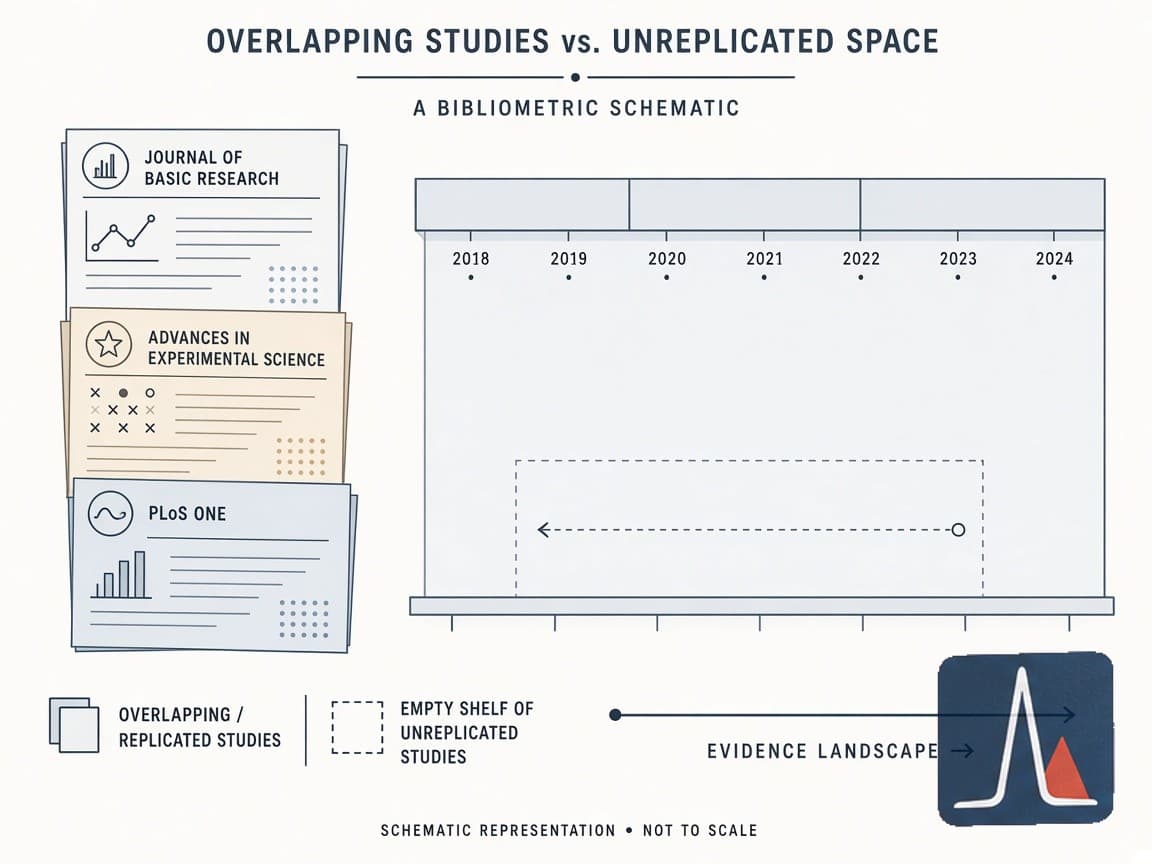
“5-Amino-1MQ: Evidence Ledger” (Vialog editorial team, 2026; https://vialog.org/compounds/5-amino-1mq/) states that most published in-vivo efficacy data for 5-Amino-1MQ in obesity and sarcopenia models come from a single academic laboratory. This note cannot audit that claim beyond the records in the memo. Those records are consistent with a narrow author cluster, but consistency across two journal papers and a news page is not a bibliometric analysis. Readers should treat “single laboratory” as a reported concern with a weak secondary citation, then check authorship, funding, and compound source on the DOIs themselves.
Other features of this file are unfavorable to strong inference, even where the mouse direction was favorable.
The biological systems are models. Diet-induced obesity in mice and aging in mice do not reproduce human adipose distribution, habitual diet, comorbidities, concurrent medicines, or lifespan. Grip strength in a mouse is not a clinical sarcopenia endpoint. Liver histology in a diet model is not a diagnosis in a person. Carrying those words across species without a human study is a category error.
Replication is thin in this file. One 2018 journal paper, one 2024 journal paper, and a news summary do not constitute a multi-center literature. The 2018 title’s mouse clause and the 2024 metabolic paper may overlap in research lineage. Overlap would make the favorable cluster look larger than the number of independent tests. This briefing does not assert that overlap as a proven fact. It flags it as a reason not to count every citation as a new replication.
Comparator data are not summarized here. The memo does not supply a head-to-head comparison, in animals or in people, against other NNMT inhibitors with enough methodological detail to rank compounds. Ranking them from a supplier note would be an invention. Public availability of a chemical name does not fill that gap.
Adverse findings are not among the retained claims. The 2018 and 2024 papers may contain tolerability notes in mice that this memo did not extract. Silence in a briefing is not evidence of a clean safety record. No human adverse-event dataset was identified. Unknown harm is not the same thing as demonstrated harm, and it is not the same thing as demonstrated safety.
Commercial pages in the citation list discuss the compound in consumer language, including words such as side effects and dosage. Those pages are used here only for the null-trial statement and the single-laboratory statement. They are not authorities for effects. Their framing is not adopted.
What a laboratory reader can carry forward
A defensible summary is short, and it stays inside the study types above.
In cell and biochemical assays, a 2018 paper reported that 5-amino-1-methylquinolinium inhibits NNMT, is membrane-permeable in the systems tested, lowers intracellular 1-MNA, and shifts NAD+ and SAM-related readouts. Study type: in vitro. Limitation: assay conditions are not pharmacology in animals or in people, and the potency number is deliberately not repeated here.
In diet-induced obese mice, a 2024 paper reported less gain in body weight and fat mass, changes in glucose and insulin measures, and less liver fat accumulation and macrophage infiltration under the authors’ model. Study type: animal. Limitation: preclinical, translation unknown, independent replication not shown in this file. The paper’s title is not a claim about the catalog vial.
A 2024 news page describes higher grip strength in aged mice, including a larger change when exercise was part of the design. Study type: animal, via secondary reporting. Limitation: no DOI or PMID in this briefing, and the percentages are not confirmed here against a journal PDF.
No human study was identified in the sources used. The statement rests on an editorial webpage, not on a trial report. Limitation: absence is not proof of safety, not proof of efficacy, and not proof that a null trial was conducted.
In theory, the cell and mouse cluster makes it plausible that a laboratory already studying NNMT would measure 1-MNA, NAD+ species, SAM-related metabolites, and the liver and adipose histology the 2024 paper already used, if that laboratory’s own protocol called for those endpoints. That plausibility is a hypothesis about experimental design. It is not a prediction that people will lose fat or gain strength. It is not a result in people. It is not a property of the research material on the shelf.
The unfavorable and null side of the same file should stay in view. There is no human trial to set beside the mouse papers. There is no retained experiment in which the compound failed a prespecified endpoint, which means failure has not been fairly tested in this note either. There is a credible concern, weakly sourced, that the in-vivo efficacy literature is concentrated in one laboratory. There is a secondary grip-strength claim that this briefing cannot verify. None of those limits is repaired by describing the favorable mouse readouts a second time.
Materials on this site are for laboratory research only. They are not medicines. A certificate of analysis, a DOI, and a catalog listing answer different questions, and none of them is a clinical authorization.
Sources
Neelakantan H et al. Selective and membrane-permeable small molecule inhibitors of nicotinamide N-methyltransferase reverse high fat diet-induced obesity in mice. Biochemical Pharmacology. 2018. Study type: in vitro, with an animal-model claim in the title that is not re-dosed here. Limitation: cell-assay conditions do not predict clinical pharmacology. DOI: 10.1016/j.bcp.2017.11.007. PMID: 29155147. https://pmc.ncbi.nlm.nih.gov/articles/PMC5826726/
Babula JJ et al. Nicotinamide N-methyltransferase inhibition mitigates obesity-related metabolic dysfunction. 2024. Study type: animal model. Limitation: preclinical diet-induced obese mice, translation unknown, replication not shown in this file. DOI: 10.1111/dom.15879. https://doi.org/10.1111/dom.15879
Watowich SJ et al., as named on a secondary news page. New Insights on Muscle Strength: The Role of Inhibiting an Enzyme that Hinders NAD+ Synthesis. 2024. Study type: animal model, secondary report only. Limitation: no DOI or PMID in this briefing; not a substitute for the primary paper. https://www.nmn.com/news/new-insights-on-muscle-strength-the-role-of-inhibiting-an-enzyme-that-hinders-nad-synthesis
Molecular Recovery editorial team. 5-Amino-1MQ: research, side effects and dosage in studies. 2026. Study type: editorial webpage, not an indexed systematic review. Used only for the statement that no human trial was identified. Limitation: absence of trials is not evidence of safety or efficacy; dosage content was not extracted. https://molecularrecovery.com/en/peptides/5-amino-1mq/
Vialog editorial team. 5-Amino-1MQ: Evidence Ledger. 2026. Study type: editorial webpage. Used only for the single-laboratory concern. Limitation: not an independent bibliometric study. https://vialog.org/compounds/5-amino-1mq/
More briefings
- Survodutide Dual Agonist: Preclinical and Clinical EvidenceThe open-catalog entry for survodutide describes a synthetic acylated 29-amino-acid peptide dual agonist of glucagon and GLP-1 receptors supplied as high-purity lyophilized powder for laboratory metabolic research. Randomised trials report
- Dulaglutide: GLP-1 Receptor Agonist in Metabolic CareDulaglutide is a recombinant Fc-fusion GLP-1 receptor agonist engineered for once-weekly administration in laboratory and clinical metabolic research. Randomised trials report glycaemic improvements, cardiovascular risk reduction and modest
- Cagrilintide-Semaglutide Mixture: Open-Catalog Context and Metabolic Trial EvidenceThe open-catalog cagrilintide-semaglutide mixture supplies a research pairing of an amylin receptor agonist and GLP-1 receptor agonist for laboratory metabolic studies. Randomised trials of co-administration report enhanced weight loss (13–
All information and products discussed are for laboratory and research use only. Not for human or veterinary use. Not intended to diagnose, treat, cure, or prevent any disease.