
27 November 2026
GHK-Cu: chemical identity and published assays
Download PDF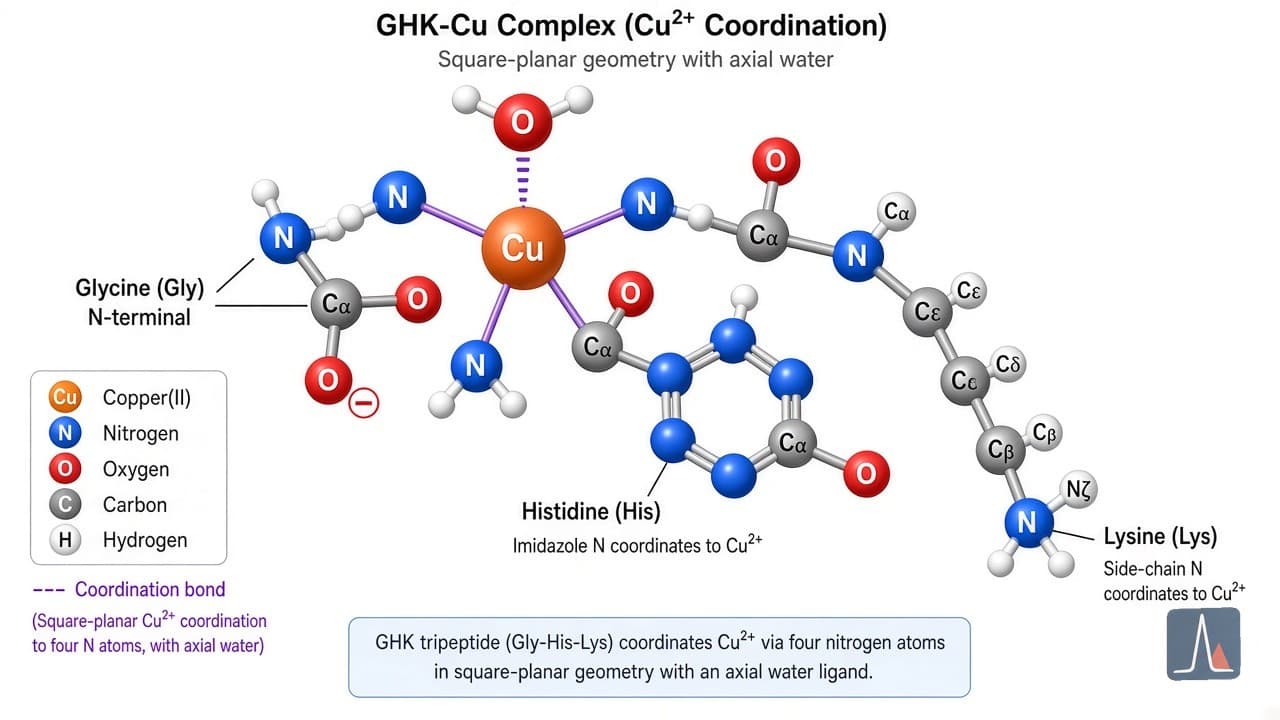
GHK-Cu is the copper(II) complex of the tripeptide glycyl-L-histidyl-L-lysine (GHK; free ligand C₁₄H₂₄N₆O₄, 340.38 Da; complex ≈C₁₄H₂₃CuN₆O₄⁺, ~403 Da, CAS 89030-95-5). Supplied exclusively as [GHK-Cu](/compounds/ghk-cu) for laboratory rese
GHK-Cu (copper tripeptide-1, prezatide copper) is the 1:1 copper(II) complex of the endogenous tripeptide glycyl-L-histidyl-L-lysine (GHK or Gly-His-Lys). The free tripeptide has the formula C₁₄H₂₄N₆O₄ and average molecular weight 340.38 Da (CAS 49557-75-7, PubChem CID 73587). The copper complex is commonly represented as C₁₄H₂₃CuN₆O₄⁺ or C₁₄H₂₂CuN₆O₄ (average MW ≈401.9–402.9 Da, monoisotopic m/z ≈402.11 for ⁶³Cu species, CAS 89030-95-5 for the complex, PubChem CID 71587328). It is supplied exclusively as GHK-Cu for laboratory research only. Materials on this site are not medicines or drugs. This briefing summarizes the chemical identity of GHK-Cu and the published assays used to characterize it. Reporting published analytical data or human trial results is not guidance to use any Rierink product in any manner.
Chemical Identity and Catalog Context
GHK was first isolated from human plasma as a growth-modulating factor. The high-affinity interaction with Cu(II) produces a stable, blue-colored complex that has been the subject of extensive coordination chemistry and analytical method development. In the Rierink catalog it sits alongside other research peptides and small molecules studied in tissue remodeling, redox, and cellular signaling models (linked compounds include glutathione, NAD, SS-31, ARA-290, Dihexa, and FOXO4-DRI). The complex is typically supplied as a blue to blue-violet lyophilized powder, often as an acetate salt, and is highly hydrophilic (log D values of –2.38 to –2.49 across pH 4.5–7.4).
Primary Sequence, Copper Coordination, and Physicochemical Properties
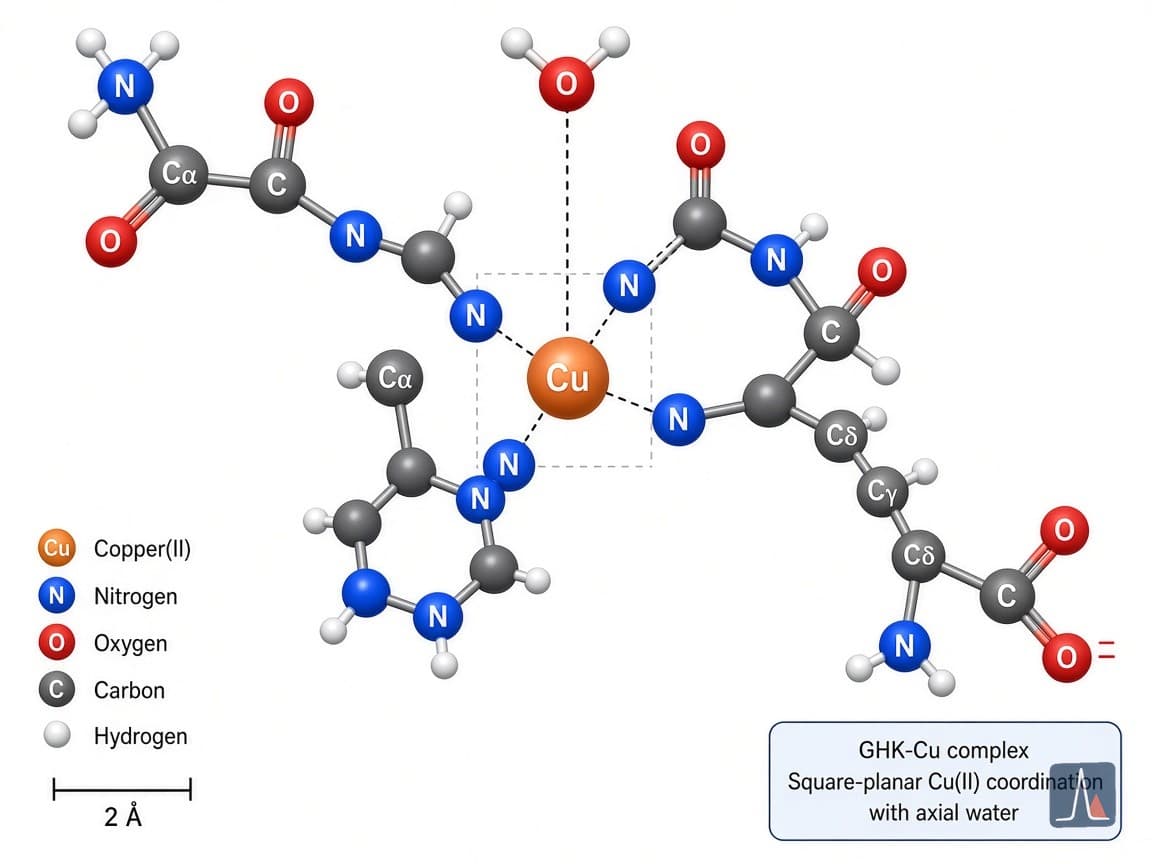
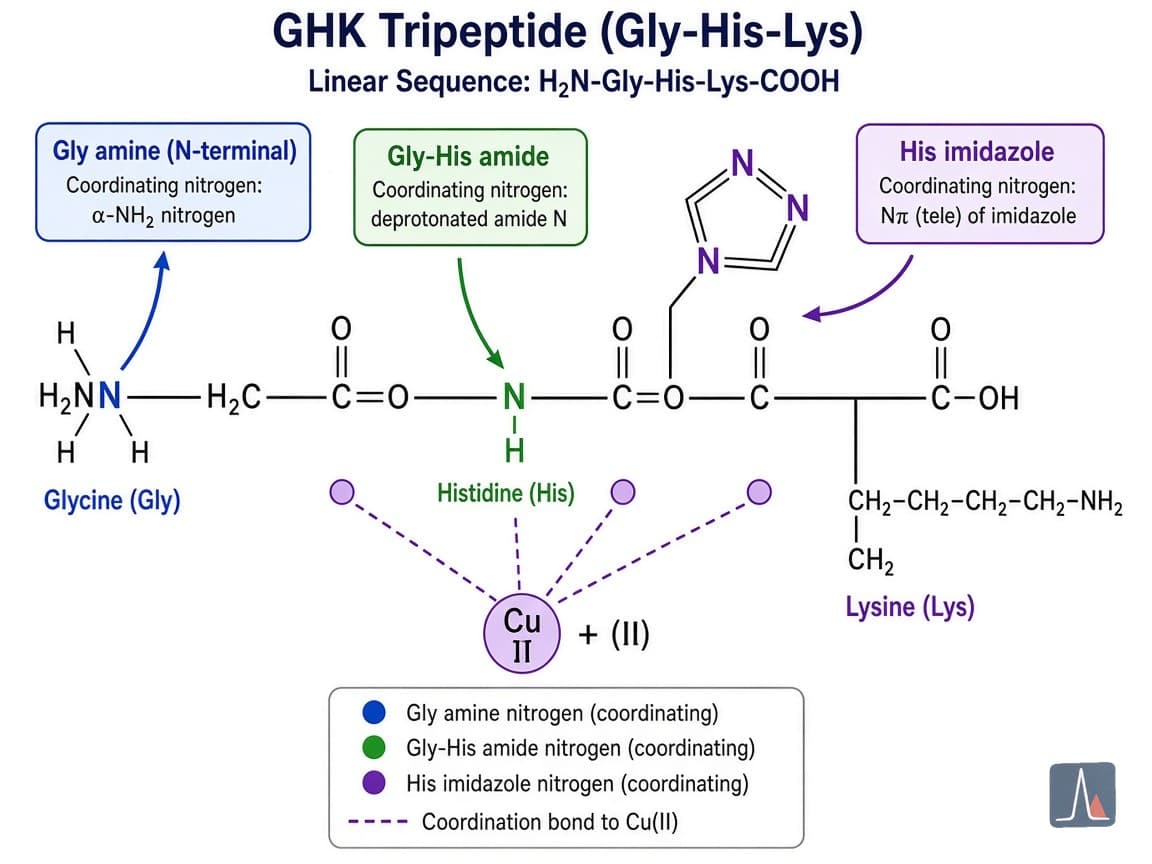
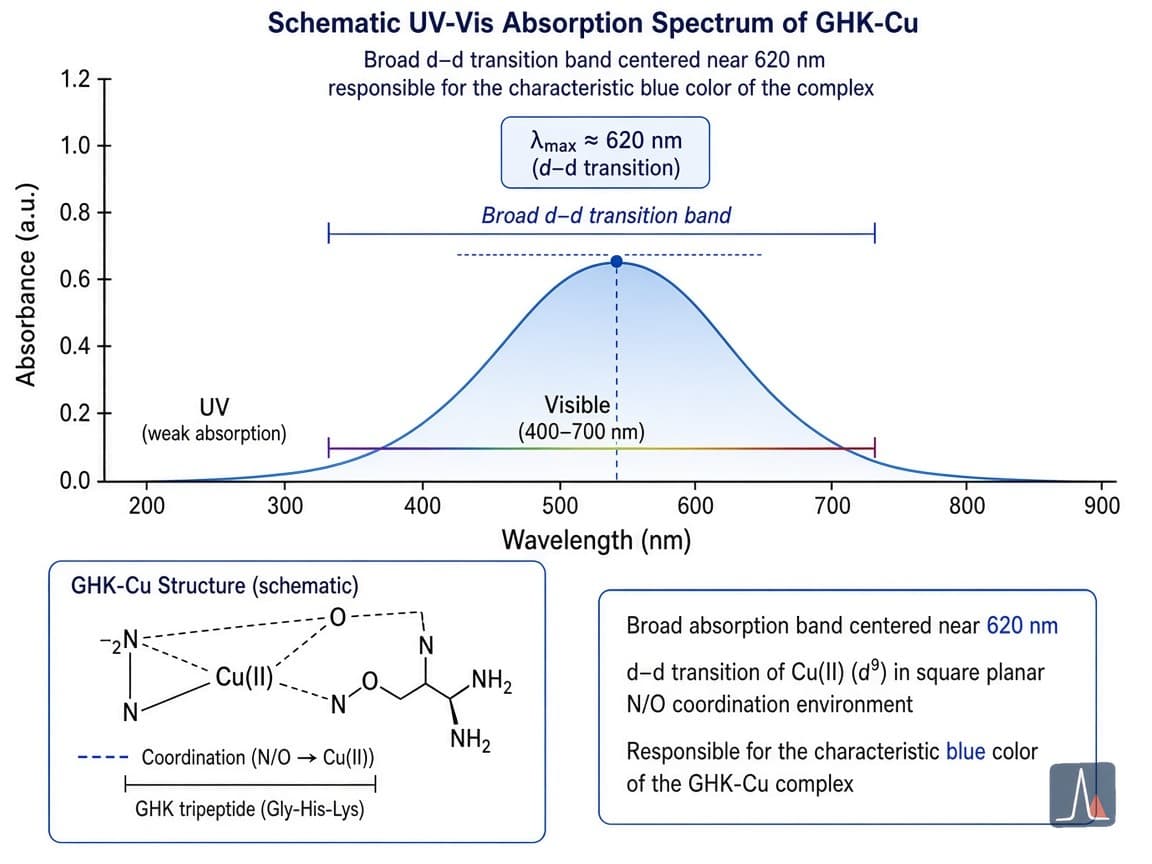
The primary sequence is H-Gly-His-Lys-OH. Copper(II) is coordinated in a predominantly square-planar (3N1O) geometry by three nitrogen atoms: the N-terminal α-amino nitrogen of glycine, the deprotonated amide nitrogen of the Gly–His peptide bond, and the Nπ nitrogen of the histidine imidazole ring. The lysine ε-amino group remains protonated and available at physiological pH. In the solid state, X-ray structures show polymeric or dimeric forms with carboxylate oxygen bridging; in aqueous solution the complex is predominantly monomeric, with water occupying the fourth equatorial and an axial position. The characteristic deep blue color arises from the d–d transition (λ_max typically reported near 605–640 nm at neutral pH). The stability constant is high (log K ≈ 16.4), far exceeding that of simpler Gly-His complexes. The compound is readily soluble in water and dilute acetic acid vehicles commonly used in laboratory peptide work.
Published Chromatographic Assays for Purity, Impurities, and Stability
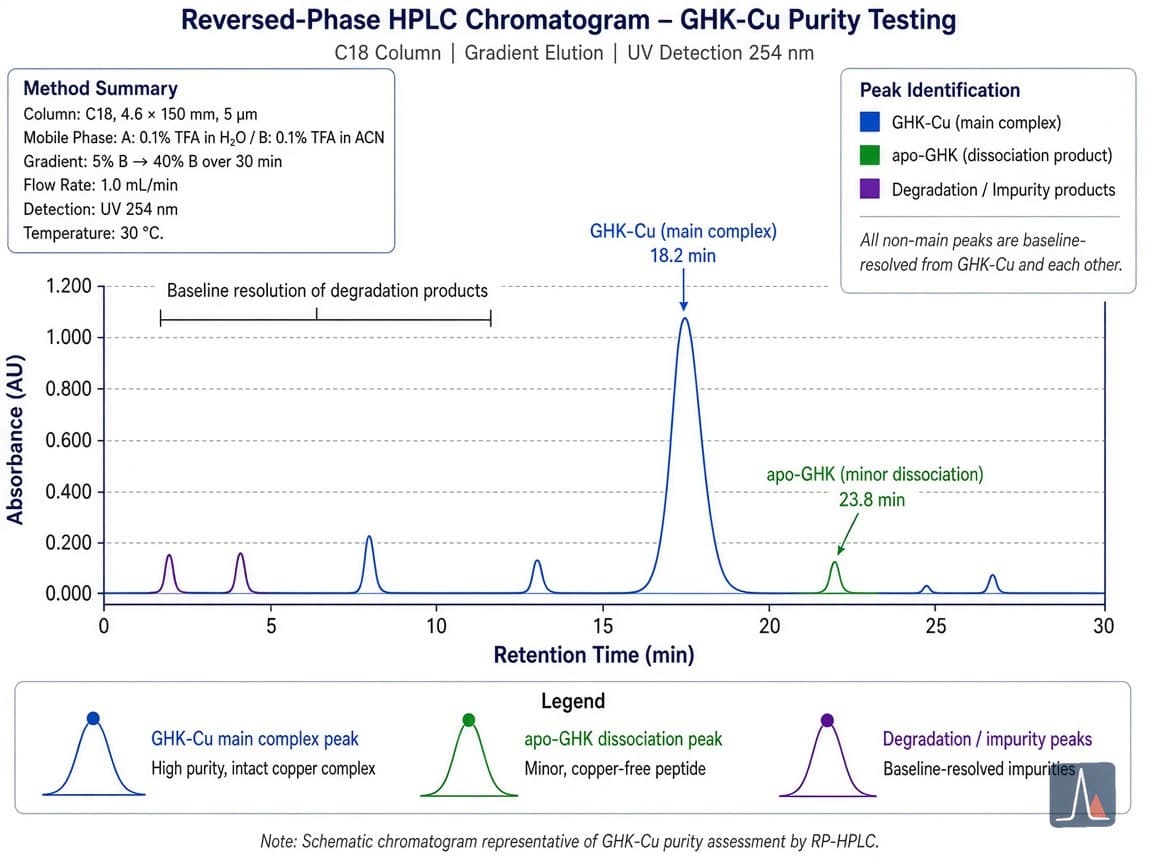
Reversed-phase high-performance liquid chromatography (RP-HPLC) with UV detection (most commonly 210–220 nm or 254 nm) is the primary method for purity assessment. Commercial certificates of analysis routinely report chromatographic purity of 98–99.9+% by area normalization on C18 columns using acetonitrile–water gradients containing TFA or formic acid. A recurring observation is partial dissociation of the complex in acidic mobile phases, producing a small adjacent peak corresponding to the apo-GHK ligand; this behavior is explicitly noted in multiple analytical reports and is not regarded as a synthetic impurity when identity is orthogonally confirmed.
A validated stability-indicating RP-HPLC method was described by Badenhorst et al. (2016). The method quantified GHK (after dissociation) and demonstrated first-order degradation kinetics under stressed conditions. The peptide was most susceptible to hydrolytic cleavage under basic and oxidative (hydrogen peroxide) stress and, to a lesser extent, acidic stress. Surprisingly, GHK-Cu was stable in water and pH 4.5–7.4 buffers for at least two weeks at 60 °C. HPLC coupled with mass spectrometry identified three major degradation products, one of which was free histidine. Alternative or complementary methods include hydrophilic interaction liquid chromatography (HILIC-UV) with ammonium formate buffers, mixed-mode columns (e.g., Primesep 200), and evaporative light-scattering detection. These assays are also used to monitor related substances, residual solvents, counterions (acetate), water content (Karl Fischer), and compatibility with formulation excipients such as niosomes.
Mass Spectrometric Assays and Copper Isotopic Confirmation
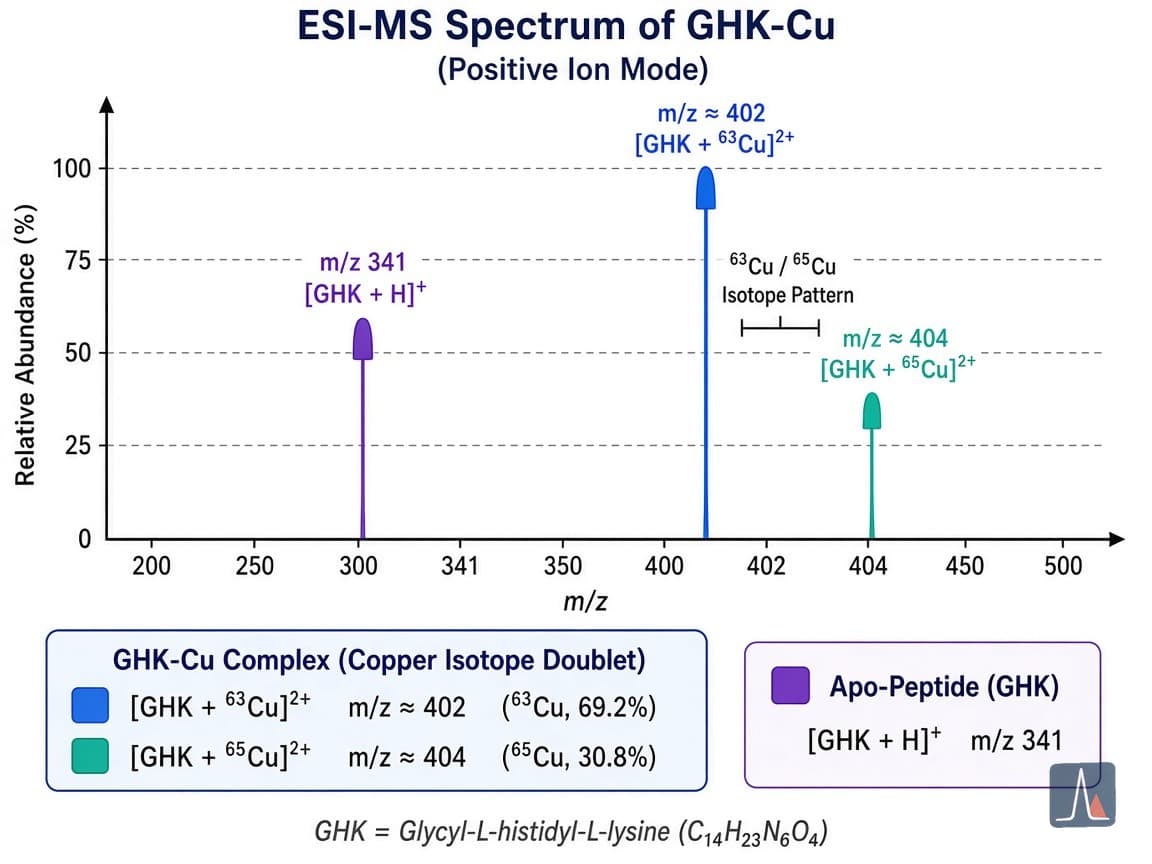
Liquid chromatography–mass spectrometry (LC-MS) or direct electrospray ionization mass spectrometry (ESI-MS) is the cornerstone of identity confirmation. Spectra commonly show the protonated apo-peptide at m/z 341.2 ([GHK+H]⁺) because the complex readily dissociates under typical ionization conditions. When softer conditions or specific source parameters are used, the copper-containing ion appears near m/z 402.1/404.1. The diagnostic natural-abundance copper isotopic doublet (⁶³Cu:⁶⁵Cu ≈ 69:31 ratio, peaks separated by 2 Da) provides unambiguous evidence that copper is present in the correct stoichiometry. High-resolution accurate-mass measurements typically match the expected monoisotopic mass to within 5 ppm. MS/MS fragmentation can further confirm the tripeptide sequence. Certificates of analysis almost invariably pair the HPLC purity result with an LC-MS identity test that includes the copper isotope signature. Elemental analysis (ICP-MS or ICP-OES) is frequently used in parallel to quantify total copper content (typical specification range 10–16% by weight, theoretical ≈15.8% for anhydrous 1:1 complex) and thereby calculate metal occupancy.
UV-Vis, EPR, CD, NMR, and Biophysical Characterization
The intact GHK-Cu complex exhibits a broad ligand-field (d–d) absorption band centered between 605 and 640 nm (frequently cited near 606–630 nm at pH 7.4), which is responsible for its intense blue color and serves as a convenient, non-destructive indicator of proper coordination and copper loading. This band is distinctly different from the spectrum of free aqueous Cu²⁺ (λ_max ≈ 810 nm). Ligand-to-metal charge-transfer transitions appear in the ultraviolet region (≈246 nm). Circular dichroism (CD) and electron paramagnetic resonance (EPR) spectroscopy have been used extensively to map pH-dependent speciation and confirm the 3-nitrogen equatorial coordination (characteristic superhyperfine structure in EPR). Early work by Freedman et al. (1982) combined optical, EPR, and electron spin-echo envelope modulation spectroscopies to demonstrate that at neutral pH the dominant species is a mononuclear 1:1 complex with one imidazole nitrogen ligand. Potentiometric titrations combined with spectroscopic detection have defined stability constants and speciation diagrams, showing that the physiologically relevant Cu(GHK) species predominates near pH 7.4. Solution NMR has been used on the metal-free peptide and diamagnetic analogs; the paramagnetic Cu(II) broadens signals in the direct complex. X-ray crystallography (Hureau et al., 2011 and earlier studies) provided the solid-state structure, revealing oxygen-bridged dimers or polymers that dissociate into the monomeric solution species. These orthogonal spectroscopic and biophysical methods collectively establish both the primary structure and the precise coordination geometry required for the biologically relevant form of the complex.
Evidence Context, Recurrent Limitations, and Catalog Implications
The analytical literature on GHK-Cu is mature and spans coordination chemistry (potentiometry, EPR, UV-Vis, CD, X-ray), chromatographic method validation, and stress-stability studies. Primary references include detailed spectroscopic characterization (Freedman 1982), equilibrium and biological-activity studies (Conato 2001), preformulation and stability work (Badenhorst 2016), and structural comparisons with related peptides (Hureau 2011). These studies consistently show that full characterization requires multiple orthogonal techniques because chromatographic purity alone reports primarily on the organic ligand once dissociation occurs in acidic eluents.
Recurrent limitations include batch-to-batch variability in exact copper occupancy and counterion content, the sensitivity of the complex to strong reductants or extreme pH (which can strip copper or promote hydrolysis), and the fact that standard acidic RP-HPLC conditions do not preserve the intact metallopeptide. Therefore, reliable catalog material should be accompanied by a COA that reports (1) chromatographic purity ≥98%, (2) MS confirmation including the copper isotopic pattern or accurate mass match, (3) visible absorbance or copper elemental analysis to confirm coordination and stoichiometry, (4) water and counterion content, and (5) endotoxin results where applicable. Users are encouraged to verify these parameters upon receipt and to employ appropriate vehicles (e.g., dilute acetic acid or bacteriostatic water) for laboratory reconstitution and short-term storage consistent with the published stability data. Such practices ensure reproducible results when GHK-Cu is used as a research tool alongside related catalog compounds in cellular, biochemical, or tissue-culture models.
Sources
- Badenhorst T, Svirskis D, Wu Z. Physicochemical characterization of native glycyl-l-histidyl-l-lysine tripeptide for wound healing and anti-aging: a preformulation study for dermal delivery. *Pharm Dev Technol*. 2016;21(2):152-160. doi:10.3109/10837450.2014.979944. PMID: 25384620. (stability-indicating RP-HPLC, degradation kinetics, MS identification of histidine and other products, log D, buffer stability).
- Freedman JH, et al. Structure of the Glycyl-L-histidyl-L-lysine--copper(II) complex in solution. *Biochemistry*. 1982;21(19):4540-4544. doi:10.1021/bi00262a004. PMID: 6291585. (optical, EPR, electron spin-echo studies establishing solution coordination).
- Conato C, et al. Copper complexes of glycyl-histidyl-lysine and two of its synthetic analogues: chemical behaviour and biological activity. *Biochim Biophys Acta*. 2001;1526(2):199-210. doi:10.1016/s0304-4165(01)00127-1. PMID: 11325542. (potentiometry, calorimetry, UV-Vis, CD, EPR; stability constants and speciation).
- Hureau C, et al. X-ray and solution structures of Cu(II) GHK and Cu(II) DAHK complexes: influence on their redox properties. *Inorg Chem*. 2011. (X-ray, EPR, HYSCORE, NMR, redox behavior).
- Additional speciation, ternary complex, and theoretical studies (2020–2022 papers on UV-Vis/CD/EPR/potentiometry and DFT modeling of binding). Vendor COA examples consistently combine RP-HPLC-UV purity, LC-MS identity with Cu isotope pattern, and copper content determination.
Linked compounds: ghk-cu, glutathione, nad, ss-31, ara-290, dihexa, foxo4-dri.
Sources
- Physicochemical characterization of native glycyl-l-histidyl-l-lysine tripeptide for wound healing and anti-aging: a preformulation study for dermal delivery, 2016. https://doi.org/10.3109/10837450.2014.979944
- Structure of the Glycyl-L-histidyl-L-lysine--copper(II) complex in solution, 1982. https://doi.org/10.1021/bi00262a004
- Copper complexes of glycyl-histidyl-lysine and two of its synthetic analogues: chemical behaviour and biological activity, 2001. https://doi.org/10.1016/s0304-4165(01)00127-1
- X-ray and solution structures of Cu(II) GHK and Cu(II) DAHK complexes: influence on their redox properties, 2011. https://doi.org/10.1021/ic200969q
- Ternary Cu(II) Complex with GHK Peptide and Cis-Urocanic Acid as a Potential Physiologically Functional Copper Chelate, 2020. https://doi.org/10.3390/ijms21176190
More briefings
- KPV: chemical identity and published assaysThis briefing identifies KPV and summarizes published assays that characterize it.
- Epithalon: chemical identity and published assaysEpithalon (Ala-Glu-Asp-Gly or AEDG, C₁₄H₂₂N₄O₉, 390.35 Da) is a synthetic tetrapeptide supplied as [Epithalon](/compounds/epithalon) for laboratory research only. This briefing details its defined chemical structure together with the princi
- Semax: chemical identity and published assaysSemax (Met-Glu-His-Phe-Pro-Gly-Pro, C₃₇H₅₁N₉O₁₀S, 813.9 Da) is a synthetic heptapeptide analog of the ACTH(4–7) fragment extended by a stabilizing Pro-Gly-Pro C-terminal motif. Supplied for laboratory research only at [Semax](/compounds/sem
All information and products discussed are for laboratory and research use only. Not for human or veterinary use. Not intended to diagnose, treat, cure, or prevent any disease.