
28 November 2026
Epithalon: chemical identity and published assays
Download PDF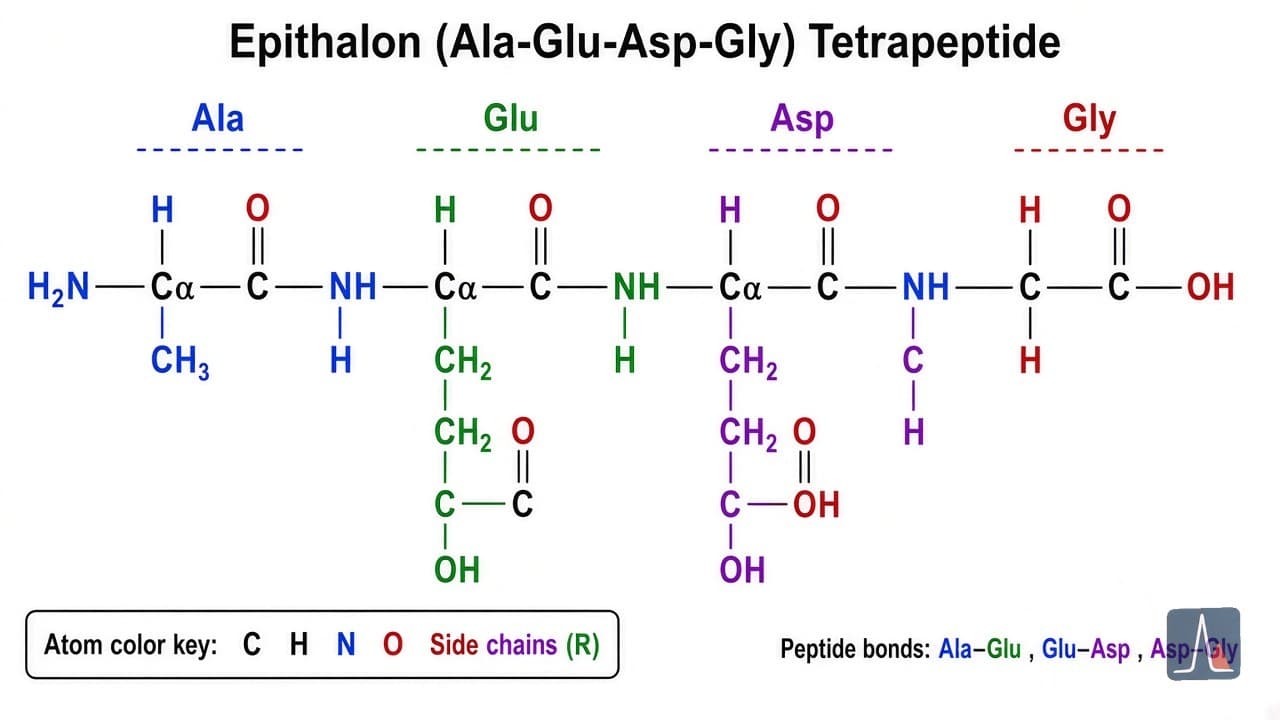
Epithalon (Ala-Glu-Asp-Gly or AEDG, C₁₄H₂₂N₄O₉, 390.35 Da) is a synthetic tetrapeptide supplied as [Epithalon](/compounds/epithalon) for laboratory research only. This briefing details its defined chemical structure together with the princi
Epithalon (also known as Epitalon or AEDG peptide; H-Ala-Glu-Asp-Gly-OH, C₁₄H₂₂N₄O₉, average molecular weight 390.35 Da, monoisotopic mass 390.1387 Da, CAS 307297-39-8) is a linear synthetic tetrapeptide supplied exclusively for laboratory research at /compounds/epithalon. It was designed on the basis of the amino-acid composition of bovine pineal epithalamin extract and is chemically distinct from the parent polypeptide mixture. This briefing summarizes its chemical identity and the chromatographic, spectrometric, spectroscopic, biophysical, and functional assays reported across peer-reviewed papers, reviews, and analytical qualification data. All materials on this site are for laboratory research only and are not medicines. Reporting published trial outcomes or cell-based results is not guidance to use any Rierink product in a living system.
Chemical Identity and Catalog Context
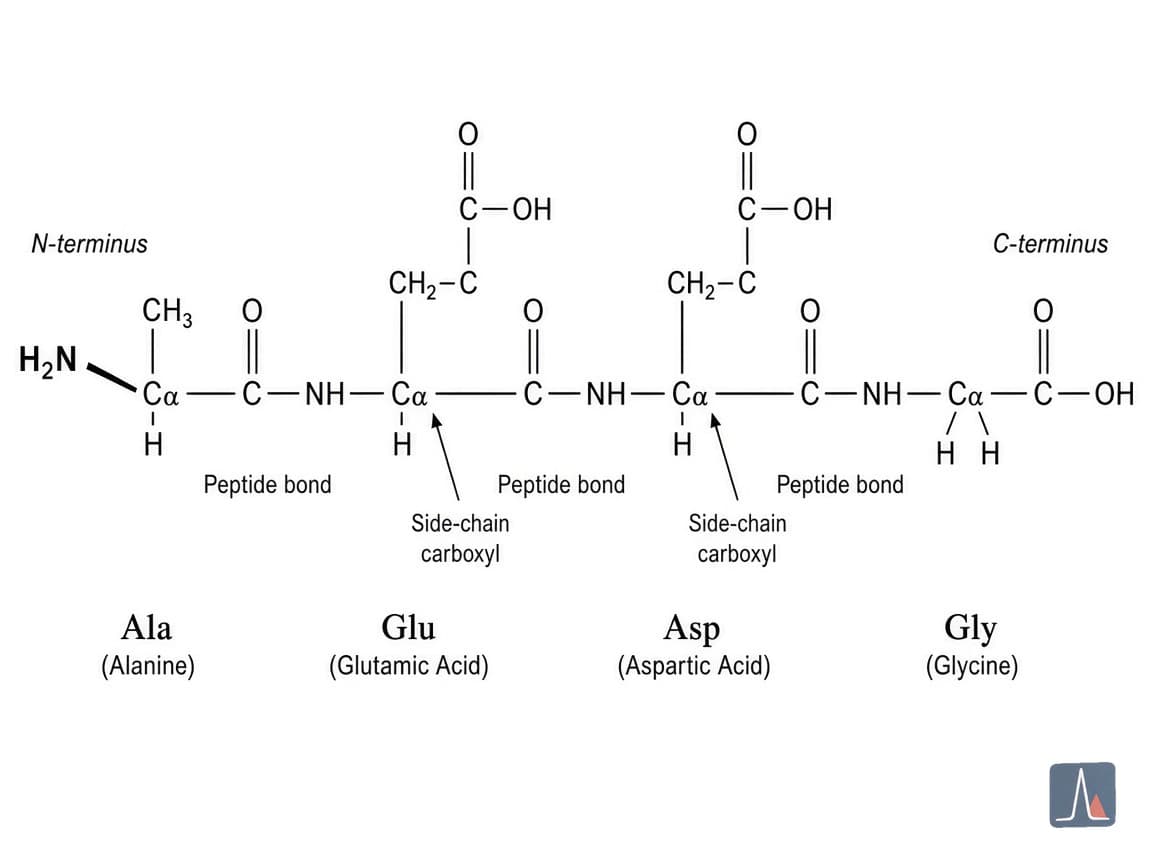
Epithalon is the defined tetrapeptide L-alanyl-L-glutamyl-L-aspartylglycine. Its PubChem record (CID 219042) gives the systematic IUPAC name (4S)-4-[[(2S)-2-aminopropanoyl]amino]-5-[[(2S)-3-carboxy-1-(carboxymethylamino)-1-oxopropan-2-yl]amino]-5-oxopentanoic acid and the InChIKey HGHOBRRUMWJWCU-FXQIFTODSA-N. The molecule contains no aromatic, sulfur-containing, or basic side chains. Three carboxyl groups (Glu side chain, Asp side chain, C-terminal Gly) and one N-terminal amine produce a strongly acidic character (theoretical pI ≈ 3.1–3.55, net charge ≈ –2 at pH 7). It is highly hydrophilic (GRAVY –1.4) and dissolves readily in water or dilute aqueous buffers without additional solubilizers. No absorbance occurs at 280 nm; quantification relies on peptide-bond absorbance at 205–220 nm. In the Rierink catalog it is offered as a lyophilized research-grade material whose lot-specific certificate of analysis must document both chromatographic purity and mass-spectrometric identity. It joins other short Khavinson-style bioregulators such as Pinealon and Thymalin in the catalog.
Primary Sequence and Physicochemical Properties
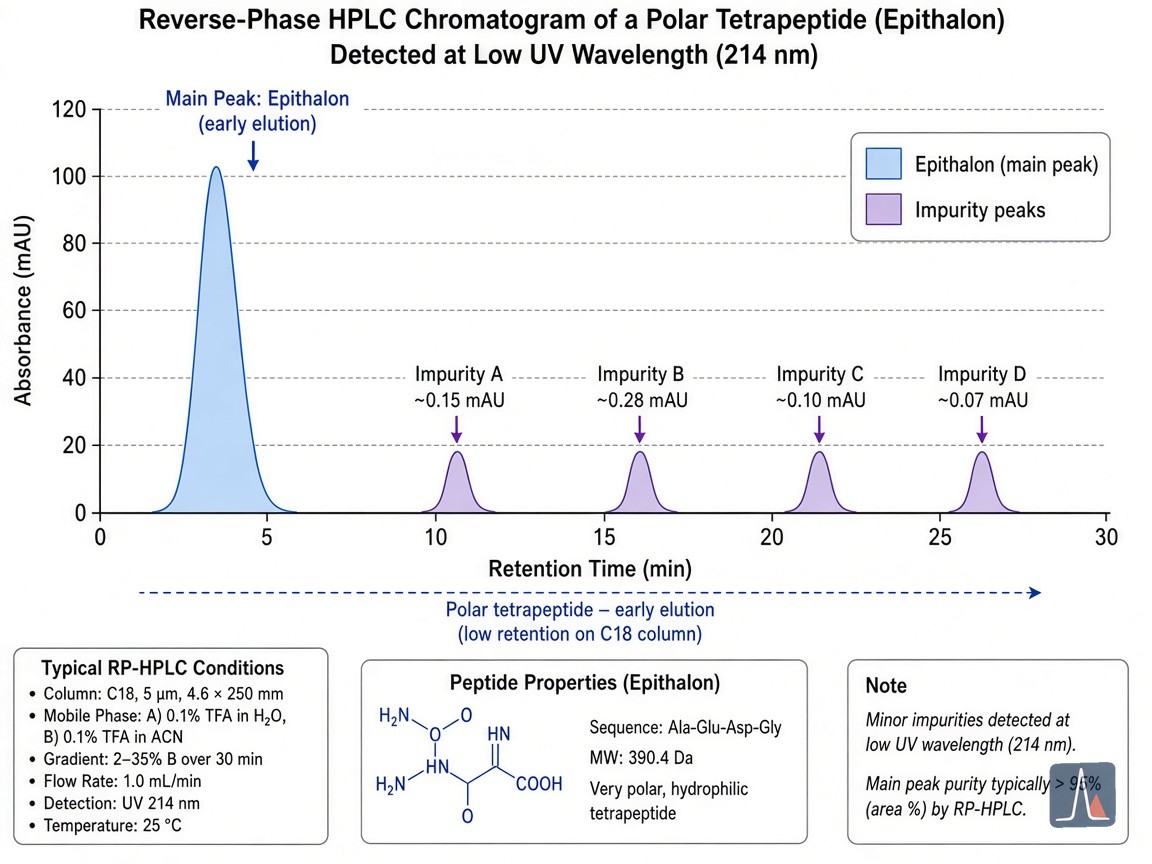
The primary structure is Ala-Glu-Asp-Gly with standard α-peptide bonds and free termini. All residues are the natural L-configuration in the material used in the majority of published studies. The Asp-Gly motif is chemically labile; it can form a succinimide (aspartimide) intermediate that opens to a mixture of α- and β-aspartyl isomers. The β-isoAsp form has identical mass but altered retention time and may appear as a closely eluting shoulder or separate peak in RP-HPLC. Thermal stability in the solid state is good when kept dry and cold (–20 °C); in aqueous solution the short peptide is susceptible to exopeptidase activity. No disulfide bonds or oxidation sites are present. These properties dictate the analytical strategy: early elution on reverse-phase columns, low-wavelength UV detection, and orthogonal mass confirmation. !RP-HPLC chromatogram schematic for Epithalon purity Representative RP-HPLC trace for Epithalon purity assessment (low-wavelength UV detection).
Published Chromatographic Assays for Purity, Impurities, and Stability
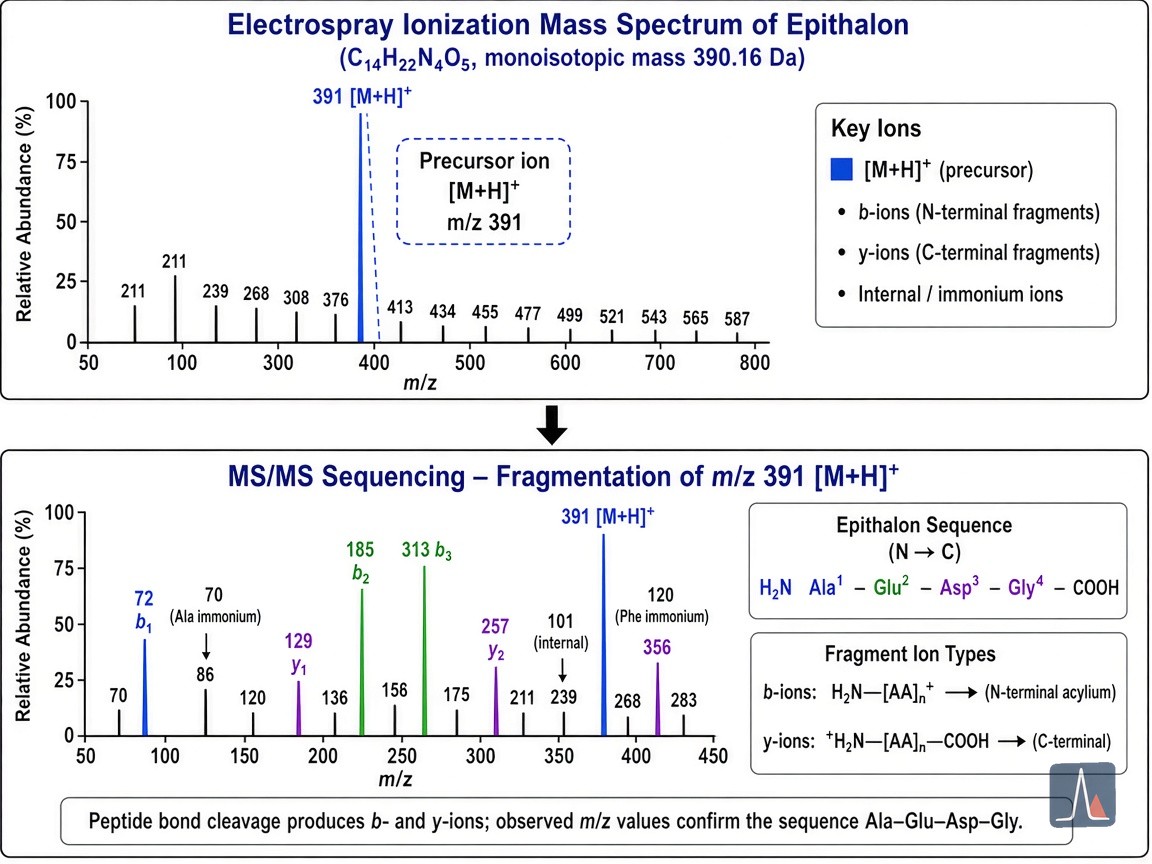
Reverse-phase HPLC on C18 columns with acidic ion-pairing mobile phases (0.1 % TFA in water/acetonitrile gradients) is the primary method reported in vendor qualification documents and synthesis papers. Detection is performed at 214 nm or 220 nm. Under typical conditions the main peak elutes early (often 4–11 min depending on gradient slope and column dimensions) because of the molecule’s high polarity. Published COA examples routinely report area-normalized purity values of 98–99.7 % for research-grade material, with the largest single impurity typically < 1 %. Common impurities include deletion sequences (e.g., des-Ala or des-Gly), aspartimide/isoAsp products, residual synthesis reagents, and occasionally bulking agents such as mannitol. Stability-indicating methods have shown that lyophilized Epithalon remains chemically intact for years at –20 °C; reconstituted solutions require cold storage and use within defined laboratory windows to limit enzymatic or chemical degradation. Orthogonal confirmation by LC-MS is universally recommended because UV detection at low wavelength cannot distinguish co-eluting isobaric species. !Mass spectrum of Epithalon ESI-MS spectrum confirming Epithalon identity (M+H+ ≈ 391.15).
Mass Spectrometric Assays and Molecular Confirmation
Electrospray ionization mass spectrometry (ESI-MS or LC-MS) is the standard identity test. The protonated molecular ion [M+H]⁺ appears at m/z 391.146 (theoretical monoisotopic). Sodium and potassium adducts (m/z 413.128 and 429.102) are frequently observed. MS/MS fragmentation produces characteristic b- and y-series ions: b₁ (Ala) m/z 72, b₂ (Ala-Glu) m/z 201, b₃ (Ala-Glu-Asp) m/z 316; y₁ (Gly) m/z 76, y₂ (Asp-Gly) m/z 191, y₃ (Glu-Asp-Gly) m/z 320. These ions allow sequence confirmation. Multiple independent laboratory reports (including those indexed across testing services) confirm measured masses within ± 0.5 Da of theory and demonstrate absence of significant deletion or insertion products. LC-MS has also been used to identify Epithalon in complex pineal polypeptide mixtures and in seized research materials, distinguishing it from isobaric tetrapeptides by retention time and fragmentation pattern. Amino-acid analysis (AAA) is occasionally reported as a complementary quantitative method confirming the 1:1:1:1 stoichiometry.
Spectroscopic, Biophysical, and Conformational Characterization
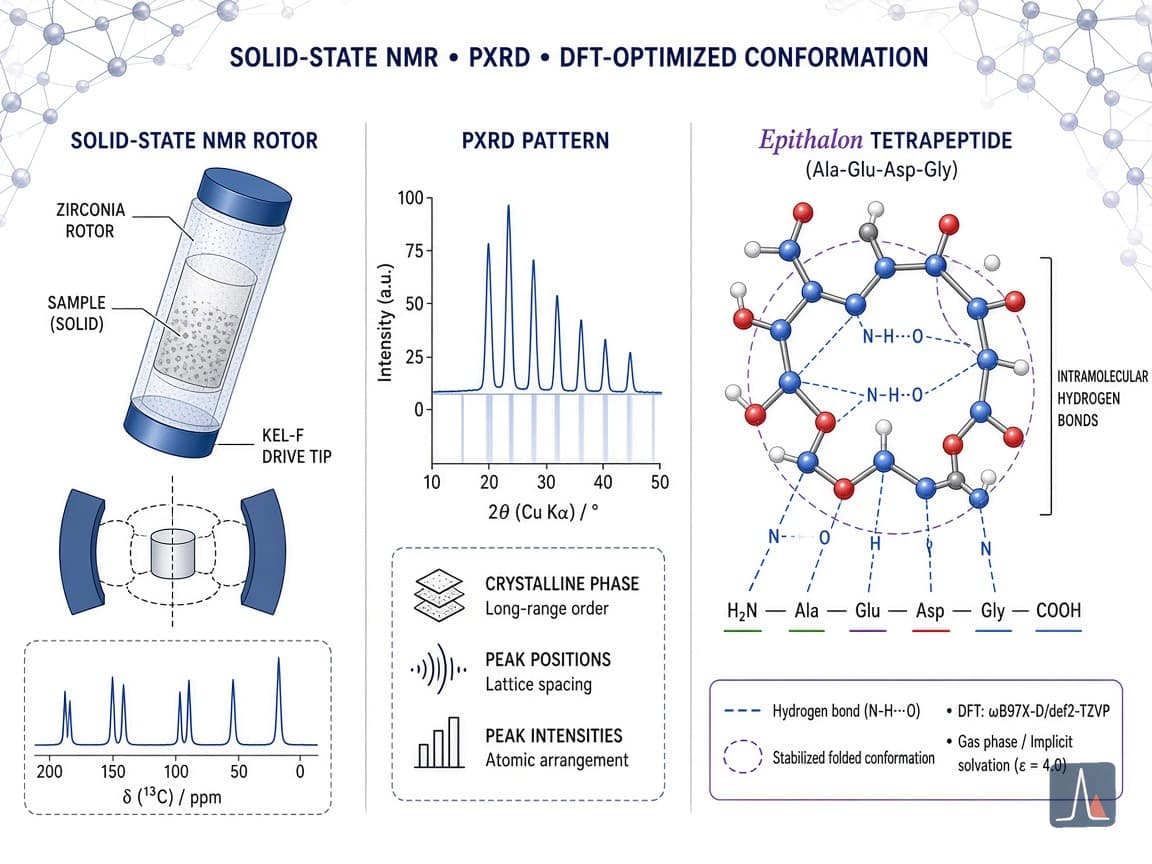
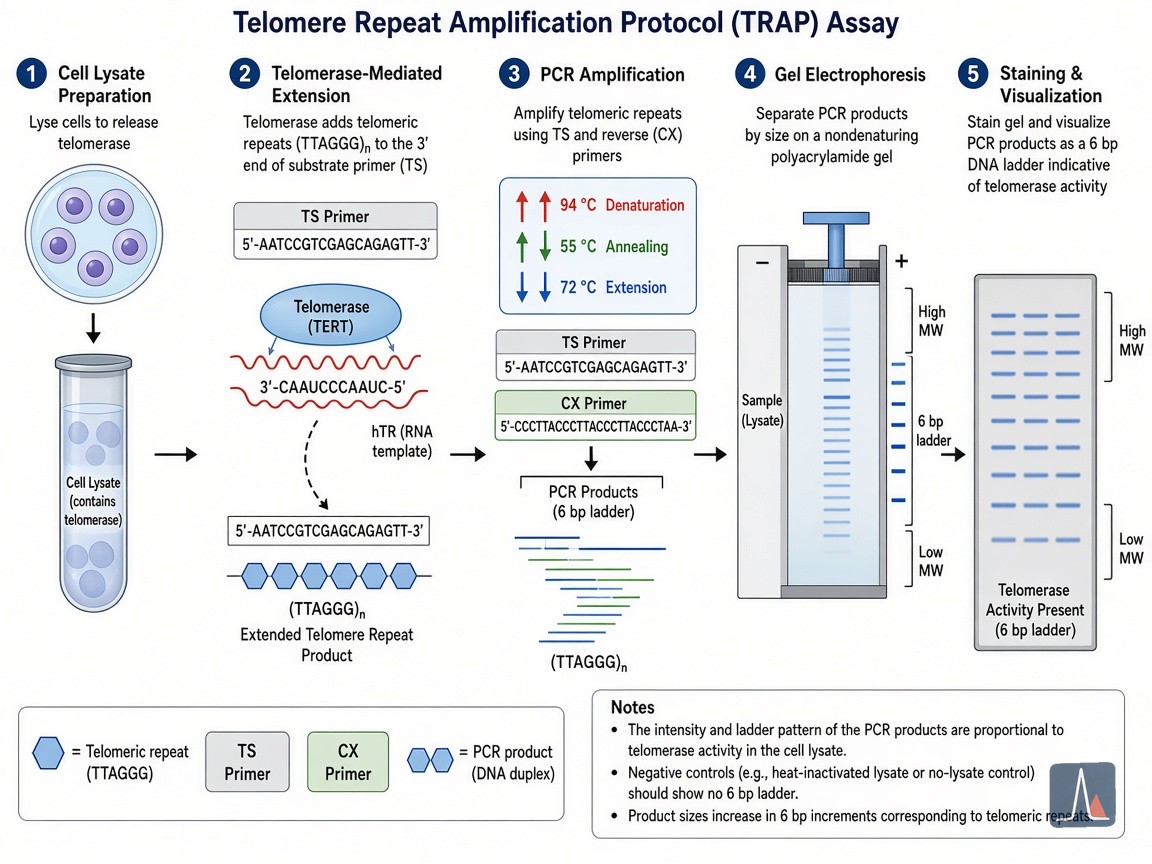
A comprehensive 2025–2027 study employed powder X-ray diffraction (PXRD), Fourier-transform infrared (FTIR) spectroscopy, differential scanning calorimetry/thermogravimetric analysis (DSC/TGA), solution and solid-state ¹³C NMR, and density-functional theory (DFT) calculations. Commercial lyophilized Epithalon is largely amorphous; recrystallization from water yields a monoclinic P2₁ crystalline form with markedly sharper FTIR bands and increased PXRD crystallinity. Solid-state CP-MAS ¹³C NMR spectra match computed chemical shifts for a compact conformation stabilized by an extensive network of intramolecular hydrogen bonds. Solution NMR (¹H, ¹³C, COSY, HMBC) confirms the linear sequence and absence of unexpected modifications. Thermal analysis shows dehydration events followed by decomposition without a clear melting point, consistent with a peptide hydrate. These data represent the most detailed published physico-chemical characterization and support the view that the dominant low-energy conformer in both solid and solution states is folded rather than fully extended. Circular dichroism data are sparse, as expected for a short flexible tetrapeptide lacking aromatic or disulfide constraints. !TRAP assay schematic Simplified schematic of the TRAP assay for telomerase activity.
Telomerase Activity, Telomere Length, Gene Expression, and Functional Bioassays
Functional laboratory assays focus on telomerase induction, telomere maintenance, and gene-expression endpoints, primarily in cell-culture models. The foundational 2003 study used the telomere repeat amplification protocol (TRAP) assay to demonstrate increased telomerase activity and telomere elongation in telomerase-negative human fetal fibroblasts and in certain epithelial lines after exposure to Epithalon. Subsequent work employed quantitative RT-PCR to measure upregulation of hTERT mRNA, quantitative PCR or Southern blot for telomere length (T/S ratio or terminal restriction fragment analysis), and immunofluorescence for telomere-associated proteins. Differential effects have been reported between normal and transformed cells; some 2025 studies describe telomerase-dependent lengthening in normal cells and alternative lengthening of telomeres (ALT) markers (C-circles, APB bodies) in selected cancer lines. Additional bioassays include ELISA or RIA for melatonin production in pineal explants or serum, qRT-PCR arrays for senescence-, chromatin-, and neurogenic-marker genes (e.g., Nestin, GAP43, β-III-tubulin), and cell-proliferation assays that monitor extension of replicative lifespan past the Hayflick limit. Nuclear penetration and possible direct interaction with histone H1 or chromatin have been explored by fluorescence labeling and molecular modeling. Most of these functional studies originate from the Khavinson research group with limited independent replication in Western laboratories; recent narrative reviews (2025–2026) compile the data while noting the predominance of preclinical cell and small-animal models.
Evidence Context, Recurrent Limitations, and Catalog Implications
The published analytical data establish that Epithalon is a chemically well-defined tetrapeptide whose identity is readily confirmed by orthogonal HPLC-MS methods and whose purity is routinely >98 % in research-grade material. The recent comprehensive spectroscopic and computational study fills a long-noted gap in physico-chemical characterization. Functional bioassays, particularly TRAP, hTERT qPCR, and telomere-length measurements, have been reported consistently across multiple cell models, yet the majority of mechanistic and longevity-related work comes from a single research lineage. Independent, large-scale, blinded replication in diverse laboratories is limited. No adequately powered randomized clinical trials meeting current regulatory standards have been published for any indication; earlier small physiological studies (e.g., retinitis pigmentosa) remain historical context rather than therapeutic evidence. Product-quality variability across unregulated sources underscores the necessity of lot-specific COAs that include both chromatographic purity (low-wavelength UV) and mass-spectrometric identity. In the Rierink catalog, Epithalon is supplied with the expectation that researchers will verify these parameters before use in cell, biochemical, or animal models. Stability data support long-term storage of the lyophilized powder; post-reconstitution handling follows general peptide best practices described in related catalog briefings. Future analytical work could usefully include detailed forced-degradation studies, validated stability-indicating methods under varied pH and temperature, and orthogonal techniques such as capillary electrophoresis or quantitative NMR for absolute content. Researchers are encouraged to request certificates that document both identity and purity for every lot.
Sources
- PubChem CID 219042 (Epitalon/Epithalon records).
- Araj SK et al. (2025) Overview of Epitalon—Highly Bioactive Pineal Tetrapeptide with Promising Properties. *Int J Mol Sci* (PMC11943447; DOI 10.3390/ijms26062691). Review summarizing 25 years of in-vitro, in-vivo, and in-silico data while noting limited physico-chemical characterization. 1 2
- Khavinson VK et al. (2003) Epithalon peptide induces telomerase activity and telomere elongation in human somatic cells. *Bull Exp Biol Med* (PMID 12937682; foundational TRAP assay paper).
- Comprehensive solid-state characterization paper (PXRD, FTIR, DSC/TGA, solution and ssNMR, DFT conformational analysis) by Araj, Szeleszczuk et al. (J Mol Struct, ~2026–2027).
- Multiple vendor and independent laboratory COA compilations (HPLC at 214–220 nm, ESI-MS confirmation of m/z 391.15, typical purity 98–99.7 %).
- Narrative review of mechanistic, preclinical, and limited clinical evidence (PMC13664938, 2026).
Additional primary literature indexed on PubMed/Europe PMC under “Epitalon OR Epithalon OR AEDG peptide” was consulted for assay descriptions. Vendor technical guides on RP-HPLC method development for polar tetrapeptides and MS fragmentation patterns were cross-checked against peer-reviewed reports. No claims are made beyond what is documented in the cited sources. All use remains strictly for qualified laboratory researchers.
More briefings
- KPV: chemical identity and published assaysThis briefing identifies KPV and summarizes published assays that characterize it.
- Semax: chemical identity and published assaysSemax (Met-Glu-His-Phe-Pro-Gly-Pro, C₃₇H₅₁N₉O₁₀S, 813.9 Da) is a synthetic heptapeptide analog of the ACTH(4–7) fragment extended by a stabilizing Pro-Gly-Pro C-terminal motif. Supplied for laboratory research only at [Semax](/compounds/sem
- GHK-Cu: chemical identity and published assaysGHK-Cu is the copper(II) complex of the tripeptide glycyl-L-histidyl-L-lysine (GHK; free ligand C₁₄H₂₄N₆O₄, 340.38 Da; complex ≈C₁₄H₂₃CuN₆O₄⁺, ~403 Da, CAS 89030-95-5). Supplied exclusively as [GHK-Cu](/compounds/ghk-cu) for laboratory rese
All information and products discussed are for laboratory and research use only. Not for human or veterinary use. Not intended to diagnose, treat, cure, or prevent any disease.